MCQ
Which error is removed when the known and unknown resistances are interchanged in a Meter Bridge?
- APercentage error
- BMeasurement error
- CEnd error
- DIndex error
Explanation:
End error is removed when the known and unknown resistances are interchanged in a Meter Bridge. This additional length has a resistance known as end resistance. So, when an end error arises, it can be removed by interchanging the known and unknown resistances and taking the mean of the resistances determined.
Generate a complete, print-ready paper with questions like this in minutes — across 16+ boards, with answer keys.
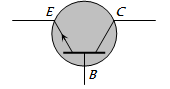
The symbol given in figure represents
|
(a) NPN transistor |
(b) PNP transistor |
|
(c) Forward biased PN junction diode |
(d) Reverse biased NP junction diode |
The total charge induced in a conducting loop when it is moved in magnetic field depends on
|
(a) The rate of change of magnetic flux |
(b) Initial magnetic flux only |
|
(c) The total change in magnetic flux |
(d) Final magnetic flux only |
In  solution when electric current equal to 2.5 faraday is passed, the gm equivalent deposited on the cathode is
|
(a) 1 |
(b) 1.5 |
(c) 2 |
(d) 2.5 |
The de-Broglie wavelength of a particle accelerated with 150 volt potential is  m. If it is accelerated by 600 volts p.d., its wavelength will be
|
(a) 0.25 Å |
(b) 0.5 Å |
(c) 1.5 Å |
(d) 2 Å |
Motion of a moving electron is not affected by
|
(a) An electric field applied in the direction of motion |
|
(b) Magnetic field applied in the direction of motion |
|
(c) Electric field applied perpendicular to the direction of motion |
|
(d) Magnetic field applied perpendicular to the direction of motion |
If a coil made of conducting wires is rotated between poles pieces of the permanent magnet. The motion will generate a current and this device is called
|
(a) An electric motor |
(b) An electric generator |
|
(c) An electromagnet |
(d) All of above |
An infinite ladder network is arranged with resistances R and 2 R as shown. The effective resistance between terminals A and B is

|
(a) ∞ |
(b) R |
(c) 2 R |
(d) 3 R |
The electric bulbs have tungsten filaments of same length. If one of them gives 60 watt and other 100 watt, then
|
(a) 100 watt bulb has thicker filament |
|
(b) 60 watt bulb has thicker filament |
|
(c) Both filaments are of same thickness |
|
(d) It is possible to get different wattage unless the lengths are different |