MCQ
Which gives lactic acid on hydrolysis after reacting with $HCN$
  • A
    $HCHO$
  • $C{H_3}CHO$
  • C
    ${C_6}{H_5}CHO$
  • D
    $C{H_3}COC{H_3}$

Answer

Correct option: B.
$C{H_3}CHO$
b
(b)$C{H_3}CHO\xrightarrow{{HCN}}C{H_3}CH(OH)\,CN\xrightarrow{{2{H_2}O/{H^ + }}}$  $C{H_3}CH(OH)\,COOH$

Need a full question paper?

Generate a complete, print-ready paper with questions like this in minutes — across 16+ boards, with answer keys.

Start Generating Free

Similar questions

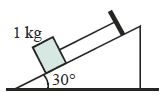
The coefficient of friction between two surfaces is $\mu  = 0.8$.The tension in the string shown in the figure is ........ $N$ 
The source producing sound and an observer both are moving along the direction of propagation of sound waves. If the respective velocities of sound, source and an observer are $v,  {v_s}$ and ${v_o}$, then the apparent frequency heard by the observer will be ($n =$ frequency of sound)
The formula $X = 5YZ^2$,  $X$ and $Z$ have dimensions of capacitance and magnetic field respectively. What are the dimensions of $Y$ in $SI$ units?
A planet of mass $M$ has a satellite of mass m, revolving around the planet in a circular orbit of radius $r$ and time period $T$ . The mass $(M)$ of the planet is
Two capillaries made of same material but of different radii are dipped in a liquid. The rise of liquid in one capillary is $2.2\, cm$ and that in the other is $6.6\, cm$. The ratio of their radii is
A charge $q$ is placed at the center of one of the surface of a cube. The flux linked with the cube is :-
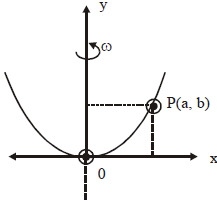
A bead of mass $m$ stays at point $P ( a , b )$ on a wire bent in the shape of a parabola $y=4 Cx ^{2}$ and rotating with angular speed $\omega$ (see figure). The value of $\omega$ is (neglect friction)
Two polaroids are placed in the path of unpolarized beam of intensity $I_0$ such that no light is emitted from the second polaroid. If a third polaroid whose polarization axis makes an angle $\theta $ with the polarization axis of first polaroid, is placed between these polaroids, then the intensity of light emerging from the last polaroid will be 
A railway compartment is lit up by thirteen lamps each taking $2.1\, amp$ at $15\, volts$. The heat generated per second in each lamp will be ............ $cal$
A microscope is focussed on a mark on a piece of paper and then a slab of glass of thickness $3\,\, cm$ and refractive index $1.5$ is placed over the mark. How should the microscope be moved to get the mark in focus again?