MCQ
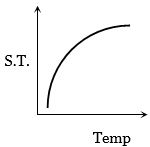
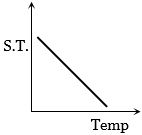
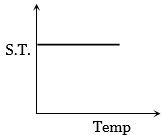
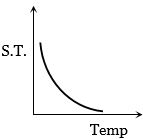
Which graph represents the variation of surface tension with temperature over small temperature ranges for water
  • A


  • C

  • D

Answer

Correct option: B.

b
(b)${T_c} = {T_o}(1 - \alpha t)$ i.e. surface tension decreases with increase in temperature.

Need a full question paper?

Generate a complete, print-ready paper with questions like this in minutes — across 16+ boards, with answer keys.

Start Generating Free

Similar questions

Two waves are approaching each other with a velocity of $16 m/s$ and frequency $n.$ The distance between two consecutive nodes is
A particle starting from the origin $(0, 0)$ moves in a straight line in the $(x, y)$ plane. Its coordinates at a later time are $(\sqrt 3 , 3) .$ The path of the particle makes with the $x-$axis an angle of ......... $^o$
A person sitting firmly over a rotating stool has his arms stretched. If he folds his arms, his angular momentum about the axis of rotation:
The AC voltage across a resistance can be measured using:
  1. A potentiometer.
  2. A hot-wire voltmeter.
  3. A moving-coil galvanometer.
  4. A moving-magnet galvanometer.
Two sources of sound placed close to each other, are emitting progressive waves given by
 $y_1 = 4\,\,sin\,\,600\pi t$ and  $y_2 = 5\,\,sin\,\,608\pi t.$

An observer located near these two sources of sound will hear
A free 238U nucleus kept in a train emits an alpha particle. When the train is stationary, a nucleus decays and a passenger measures that the separation between the alpha particle and the recoiling nucleus becomes x at time t after the decay. If the decay takes place while the train is moving at a uniform velocity v, the distance between the alpha particle and the recoiling nucleus at a time t after the decay as measured by the passenger is:
  1. x + vt
  2. x - vt
  3. x
  4. Depends on the direction of the train.
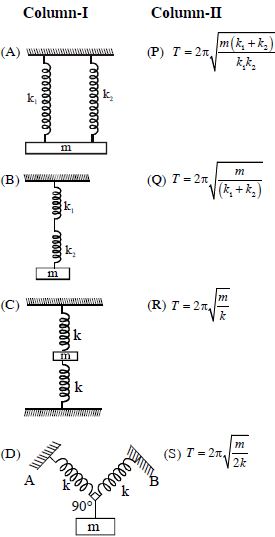
In the following questions, match column $-I$ with column $-II$ and choose the correct options
Consider a vehicle going on a horizontal road towards east. Neglect any force by the air. The frictional forces on the vehicle by the road:
  1. Is towards east if the vehicle is accelerating.
  2. Is zero if the vehicle is moving with a uniform velocity.
  3. Must be towards east.
  4. Must be towards west.
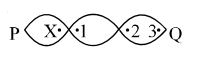
Figure, shows a stationary wave between two fixed points $P$ and $Q$. Which point$(s)$ of $1, 2$ and $3$ are in phase with the point $X?$
A $0.5\, kg$ ball is thrown up with an initial speed $14\, m/s$ and reaches a maximum height of $8.0m. $ How much energy is dissipated by air drag acting on the ball during the ascent .......... $J$