MCQ
Which has more luminous efficiency
  • A
    A $40 W$ bulb
  • A $40 W$ fluorescent tube
  • C
    Both have same
  • D
    Cannot say

Answer

Correct option: B.
A $40 W$ fluorescent tube
b
(b) Luminous efficacy is a measure of how well a light source produces visible light. It is the ratio of luminous flux to power, measured in lumens per watt in SI.Luminous efficacy can be normalized by the maximum possible luminous efficacy to a dimensionless quantity called luminous efficiency.

Luminous efficiency for the same power supply, $40 W$ fluorescent tube gives more light. Hence, $40 \mathrm{W}$ fluorescent tube has greater.

Need a full question paper?

Generate a complete, print-ready paper with questions like this in minutes — across 16+ boards, with answer keys.
Start Generating Free

Similar questions

The capacity of a parallel plate condenser is $10\,\mu F$ without dielectric. Dielectric of constant $2$ is used to fill half the distance between the plates, the new capacitance in $\mu F$ is
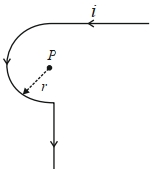
Find the magnetic field at the point $P$ in figure. The curved portion is a semicircle connected to two long straight wires.
Whenever a hydrogen atom emits a photon in the Balmer series
In Young's double slit experiment, if L is the distance between the slits and the screen upon which interference pattern is observed, x is the average distance between the adjacent fringes and d being the slit separation. The wavelength of light is given by
A 5℃ rise in temperature is observed in a conductor by passing a current. When the current is doubled the rise in temperature will be approximately
The magnetic susceptibility is negative for:
Hot wire ammeters are used for measuring
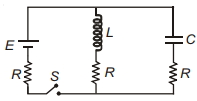
The switch shown in the circuit is closed at $t=0$. The current drawn from the battery by the circuit at $t=0$ and $t=\infty$ are in the ratio
Column $- I$ gives certain physical terms associated with flow of current through a metallic conductor. Column $- II$ gives some mathematical relations involving electrical quantities. Match Column $- I$ and Column $- II$ with appropriate relations.
Column $- I$ Column $- II$
$(A)$ Drift Velocity $(P)$ $\frac{m}{n e^{2} \rho}$
$(B)$ Electrical Resistivity $(Q)$ $\mathrm{ne} v_{\mathrm{d}}$
$(C)$ Relaxation Period $(R)$ $\frac{\mathrm{eE}}{\mathrm{m}} \tau$
$(D)$ Current Density $(S)$ $\frac{E}{J}$
A charge of 5 C is given a displacement of 0.5 m. The work done in the process is 10 J. The potential difference between the two points will be