MCQ
Which has the lowest boiling point
  • A
    $N{H_3}$
  • $P{H_3}$
  • C
    $As{H_3}$
  • D
    $Sb{H_3}$

Answer

Correct option: B.
$P{H_3}$
b
(b) 
Hydride $N{H_3}$ $P{H_3}$ $As{H_3}$ $Sb{H_3}$ $Bi{H_3}$
Boling point $238.5$ $185.5$ $10.6$ $254.6$  $290$

Need a full question paper?

Generate a complete, print-ready paper with questions like this in minutes — across 16+ boards, with answer keys.
Start Generating Free

Similar questions

$12\, g$ of a nonvolatile solute dissolved in $108\, g$ of water produces the relative lowering of vapour pressure of $0.1$. The molecular mass of the solute is 
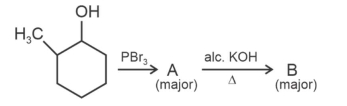
Major products $\mathrm{A}$ and $\mathrm{B}$ formed in the following reaction sequence, are
Given that $E_{{O_2}/{H_2}O}^o =  + 1.23\,V$; $E_{{S_2}O_8^{2 - }/SO_4^{2 - }}^o =   2.05\,V$; $E_{B{r_2}/B{r^ - }}^o = +1.09\,V$; $E_{A{u^{3 + }}/Au}^o = 1.4\,V$. The strongest oxidizing agent is
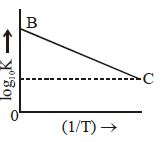
Following figure shows a graph in $log_{10}K$ vs $\frac{1}{T}$ where $K$ is rate constant and $T$ is temperature. The straight line $BC$ has slope, $tan\,\theta  = -\frac{1}{2.303}$ and an intercept of $5$ on $Y-$ axis. Thus $E_a$, the energy of activation is ....... $cal$
On electrolysis of aqueous $CuSO_4$ solution using $Cu$ electrode results in deposition of $2.5\, g$ $Cu$ at cathode then at anode
$A + H_2O \to  B + HCl, B + H_2O \to  C + HCl,$ Compound $(A), (B)$ and $(C)$ will be respectively
The total number of carbon atoms present in tyrosine, an amino acid, is .................
Which of the following is pyrimidine base?
The option(s) with only amphoteric oxides is(are)

$[A]$ $\mathrm{Cr}_2 \mathrm{O}_3, \mathrm{BeO}, \mathrm{SnO}, \mathrm{SnO}_2$

$[B]$ $\mathrm{Cr}_2 \mathrm{O}_3, \mathrm{CrO}, \mathrm{SnO}, \mathrm{PbO}$

$[C]$ $\mathrm{NO}, \mathrm{B}_2 \mathrm{O}_3, \mathrm{PbO}, \mathrm{SnO}_2$

$[D]$ $\mathrm{ZnO}, \mathrm{Al}_2 \mathrm{O}_3, \mathrm{PbO}, \mathrm{PbO}_2$

Molar conductivity $\left(\Lambda_m\right)$ of aqueous solution of sodium stearate, which behaves as a strong electrolyte, is recorded at varying concentration($c$) of sodium stearate. Which one of the following plots provides the correct representation of micelle formation in the solution?

(Critical micelle concentration ($CMC$) is marked with an arrow in the figures.)