MCQ
Which ibre comes from an animal?
  • Silk
  • B
     Nylon
  • C
     Cotton
  • D
    Polyester

Answer

Correct option: A.
Silk
Silk

Need a full question paper?

Generate a complete, print-ready paper with questions like this in minutes — across 16+ boards, with answer keys.
Start Generating Free

Similar questions

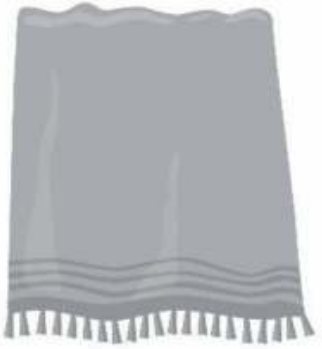
The picture shows a piece of fabric.
Image
Four friends discuss ways to ind out if the fabric is made of natural or synthetic ibres.
The table lists their suggestions.
Friend Suggestion
Tina Colour the fabric and check how well it retains colour
Amit Burn the fabric and check if it melts or burns
Sania Soak the fabric in water and check if it absorbs water
Mahesh Tear the fabric and check how strong the fabric is
$8.$Who made the correct suggestion?
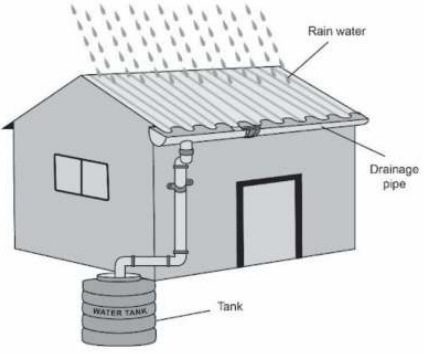
The picture shows how rainwater is stored in tanks for home use.Image
9. Is the water collected in the water tank safe for drinking? Explain your answer.
10. Why is rainwater harvesting important?
$A.$ To help plants grow better
$B.$ To reduce water pollution
$C.$ To collect water that is rich in minerals
$D.$ To reduce the demand for water supply
Fat-rich foods leave an oily patch on paper when smashed or rubbed on it.
Raju wanted to check this through an activity.
He performed the following steps.
Step $1:$ Placed a fat-rich food item on a piece of white paper
Step $2:$ Smashed the food gently with a hammer
Step $3:$ Removed the smashed food from the paper
Step $4:$ Dried the paper and then checked for any patch on it
$8.$ In Step $4$, Raju dried the paper before checking for patches.
What could be the most likely reason for this?
$9.$Raju performed the same activity with four types of food.
Which of the following will decide the amount of fat in each food item?
$A.$ The shape of the paper
$B.$ Time taken for the paper to dry
$C.$ The size of the oily patch on the paper
$D.$ Ease of smashing the food with hammer
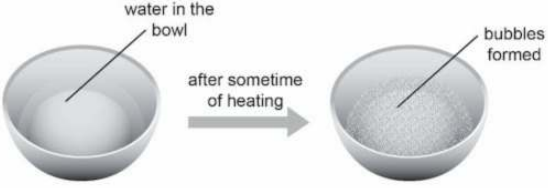
Ravi ills a steel vessel with water and starts heating it on an oven.
He notices small bubbles at the bottom of the vessel after some time.Image
$5.$ Where do the bubbles come from?
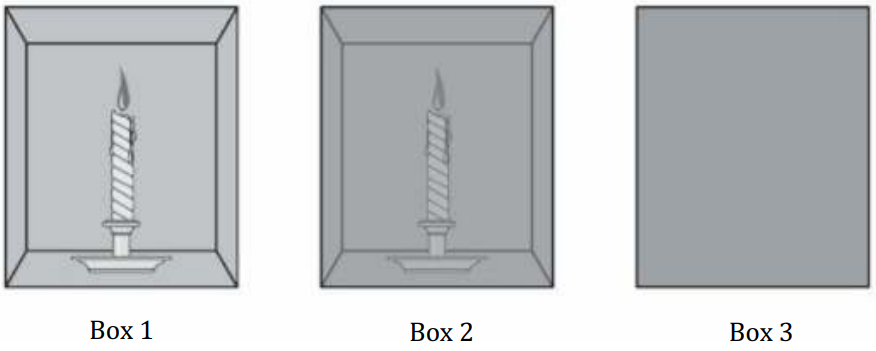
Namita has three boxes with the same thickness.
She places a burning candle inside each box.
The images show how Namita was able to view the candle through each box.Image
$7.$ Which box is made of an opaque material?
$8.$ Namita replaces box $1$ with a thicker box made of the same material and repeats the activity.
Will there be any change in the results of the activity? Explain your answer.
$9.$ Which object is commonly made of plastic?
$A.$ House gate
$B.$ Sleeping cot
$C.$ Cooking vessel
$D.$ Water bottle
$10.$ Neeraj spilled some water on the loor. He cleaned the loor using a mop. Which material is best suited for making the mop?
$A.$ Iron scrubber
$B.$ Cotton cloth
$C.$ Plastic sheet
$D.$ Copper sheet
He pours one spoon of dye on each fabric.
He then washes the fabrics with the same detergent.
Atul has four different fabrics.
The table shows what he inds after the wash.
Silk Acrylic Nylon Cotton
Light stain No stain No stain Light stain
$10.$ Which question can be answered through Atul’s activity?
Which device needs an electric cell to work?
 
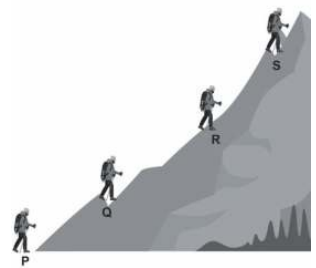
The picture shows trekkers at four different locations on a mountain.
$P, Q, R$ and $S$ are the four different locations.
Image
$6.$ At which location will a trekker need maximum oxygen from the cylinder?
$A.$ P
$B.$ Q
$C.$ R
$D.$ S
$7.$ Why is it safer to breathe through the nose than through the mouth?
$8.$ Wearing a face mask prevents germs present in the air from entering our body.
What is another beneit of wearing a face mask?
$A.$ It prevents the drying of lips.
$B.$ It helps to reduce bad breath.
$C.$ It helps to keep the face warm.
$D.$ It prevents dust from entering the body.
$9.$ Which of these actions can cause air pollution?
Circle $‘Yes’$ or $‘No’$ for the correct response.
Can this cause air pollution? $Yes$ or $No$
Using solar water heaters $Yes/No$
Burning plastic wastes $Yes/No$
Driving electric vehicles $Yes/No$
$10.$ Which is the largest component of air?
$A.$ Oxygen
$B.$ Nitrogen
$C.$ Water vapour
$D.$ Carbon dioxide
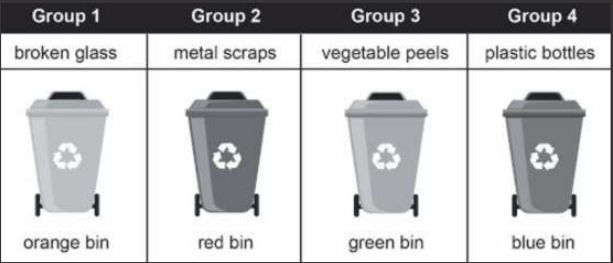
The table shows different bins used to collect different types of wastes
.Image
$1.$ The waste from which bin is suitable for composting?
$A.$ Orange
$B.$ Red
$C.$ Green
$D.$ Blue
$2.$ A children’s park has only green and blue bins.
In which bin should empty juice cans be dumped? Explain your answer.
$3.$ Why should we recycle materials?
Circle $‘Yes’ $ or $‘No’$ for the correct response.
Why do we recycle materials? $Yes$ or $No$
To save natural resources $Yes/No$
To make products stronger $Yes/No$
To create beautiful products $Yes/No$
$4.$ Why is burning of crop residue harmful?
$5.$ WWhich of these is an example of reducing waste at home?
Circle $‘Yes’$ or $‘No’ $ for the correct response.
Will this reduce waste? $Yes$ or $No$
Buying use-and-throw pens $Yes/No$
Using old cloth to make grocery bags $Yes/No$
Reusing cookie jars to store sugar $Yes/No$
$6.$ Why should plastic waste not be dumped in landills?
$A.$ It has a low melting point.
$B.$ It does not degrade over time.
$C.$ It reacts with some vegetable wastes.
$D.$ It produces harmful gases on burning.
$7.$ Should plastic waste be dumped in water bodies? Explain your answer.
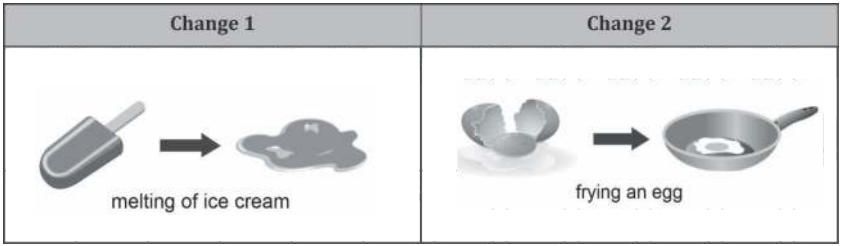
The pictures show two types of change in objects.Image
Which statement about the two changes is true?
Circle $'Yes'$ or $'No'$ for the correct response.
  $Yes$ or $No$
Change $1$ can be reversed. $Yes/No$
A new substance is formed in change $2.$ $Yes/No$
Change $1$ requires cooling but change $2$ requires heating. $Yes/No$