Question
Which important property did Mendeleev use to classify the elements in his periodictable and did he stick to that?

Answer

Mendeleev organized the components in his periodic table, according to the order of their atomic weight. Mendeleev organized the components in groups and periods according to the increasing atomic weight. Mendeleev set the elements which are having comparative properties in the similar groups.
Nonetheless, he didn’t adhere to arrangement that he gave for long. He discovered that if the elements were organized according to their increasing atomic weights, then a few elements did not match within this plan of characterization.
In this manner, he overlooked the order of atomic weights now and again. For instance, the atomic mass of iodine is lower than atomic mass of tellurium.
Still Mendeleev set tellurium (in Group 6) ahead of iodine (in Group 7) essentially in light of the fact that iodine’s properties are so comparable to fluorine, chlorine, and bromine.

Need a full question paper?

Generate a complete, print-ready paper with questions like this in minutes — across 16+ boards, with answer keys.

Start Generating Free

Similar questions

Match the type of mixture of compounds in Column I with the technique of separation/purification given in Column II.
 
Column I
 
Column II
(i)
Two solids which have different solubilities in a solvent and which do not undergo reaction when dissolved in it.
(a)
Steam distillation.
(ii)
Liquid that decomposes at its boiling point.
(b)
Fractional distillation.
(iii)
Steam volatile liquid.
(c)
Simple distillation.
(iv)
Two liquids which have boiling points close to each other.
(d)
Distillation under reduced pressure.
(v)
Two liquids with large difference in boiling points.
(e)
Crystallisation.
In the estimation of sulphur by Carius method, 0.468g of an organic sulphur compound afforded 0.668g of barium sulphate. Find out the percentage of sulphur in the given compound.
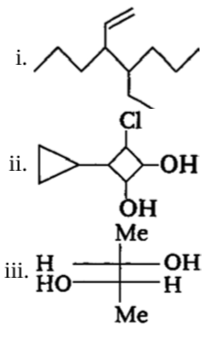
1. Give IUPAC names of the following structures.
Image
2. Benzoic acid is an organic compound. Its crude sample can be purified by crystallization from hot water. What characteristic differences in the properties of benzoic acid and the impurity make this process of purification suitable?
Determine the empirical formula of an oxide of iron, which has $69.9\%$ iron and $30.1\%$ dioxygen by mass.
Write a note on entropy and spontaneity.
Describe the properties of covalent compounds.
Classify the following reactions in one of the reaction type studied in this unit.
i. $\mathrm{CH}_3 \mathrm{CH}_2 \mathrm{Br}+\mathrm{HS}^{-} \rightarrow \mathrm{CH}_3 \mathrm{CH}_2 \mathrm{SH}+\mathrm{Br}^{-}$
ii. $(\mathrm{CH})_2 2 \mathrm{C}=\mathrm{CH} 2+\mathrm{HCl} \rightarrow\left(\mathrm{CH}_3\right)_2 \mathrm{ClC}-\mathrm{CH}_3$
iii. $\mathrm{CH}_3 \mathrm{CH}_2 \mathrm{Br}+\mathrm{HO}^{-} \rightarrow \mathrm{CH}=\mathrm{CH}_2+\mathrm{H}_2 \mathrm{O}+\mathrm{Br}^{-}$
iv. $\left(\mathrm{CH}_3\right)_3 \mathrm{C}-\mathrm{CH}_3 \mathrm{OH}+\mathrm{HBr} \rightarrow\left(\mathrm{CH}_3\right)_2 \mathrm{CBrCH}_2 \mathrm{CH}_2 \mathrm{CH}+\mathrm{H}_2 \mathrm{O}$
Explain the difference between reversible and irreversible processes.
When conc $\text{H}_2\text{SO}_4$ was added into unknown salt present in a test tube, a brown gas ‘A’ was evolved. The gas intensified when copper turnings were also added into this test tube. On cooling, the gas ‘A’ changed into a colourless gas 'B'.
  1. Identify A and B.
  2. Wrtie the equations for the reactions involved.
Enthalpies of formation of $CO ( g ), CO _2(g), N _2 O ( g )$ and $N _2 O _4(g)$ are $-110,-393,81$ and $9.7 kJ mol ^{-1}$ respectively. Find the value of $\Delta rH$ for the reaction: $N _2 O _4(g)+3 CO ( g ) \longrightarrow N _2 O ( g )+3 CO _2(g)$