MCQ
Which ion is not coloured
- A$C{r^{3 + }}$
- B$C{o^{2 + }}$
- C$C{r^{2 + }}$
- ✓$C{u^ + }$
Generate a complete, print-ready paper with questions like this in minutes — across 16+ boards, with answer keys.
$(a)$ Lewis acidity order : $SiF_4 < SiC_{4} < SiBr_4 < Sil_4$
$(b)$ Melting point : $NH_3 > SbH_3 > AsH_3 > PH_3$
$(c)$ Boiling point : $NH_3 > SbH_3 > AsH_3 > PH_3$
$(d)$ Dipole moment order : $NH_3 > SbH_3 > AsH_3 > PH_3$
$Image$
$1.$ Which one of the following reagents is used in the above reaction?
$(A)$ aq. $\mathrm{NaOH}+\mathrm{CH}_3 \mathrm{Cl}$
$(B)$ aq. $\mathrm{NaOH}+\mathrm{CH}_2 \mathrm{Cl}_2$
$(C)$ aq. $\mathrm{NaOH}+\mathrm{CHCl}_3$
$(D)$ aq. $\mathrm{NaOH}+\mathrm{CCl}_4$
$2.$ The electrophile in this reaction is
$(A)$ : $\mathrm{CHCl}$ $(B)$ ${ }^{+} \mathrm{CHCl}_2$
$(C)$ $\mathrm{CCl}_2$ $(D)$. $\mathrm{CCl}_3$
$3.$ The structure of the intermediate $I$ is
$Image$
Give the answer question $1, 2$ and $3.$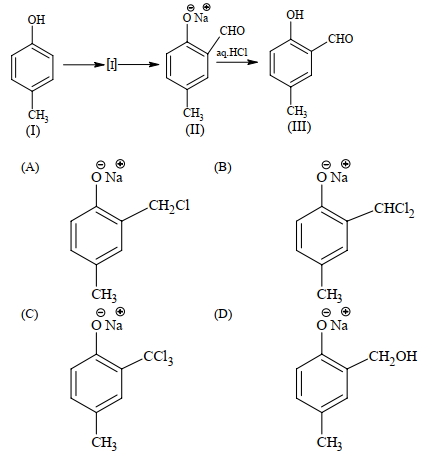
|
List $-I$ (Ion involved) |
List $-II$ (agent) |
| $(i)\, Ni^{2+}$ | $(A)$ Sodium thiosulphate |
| $(ii)\, Ag^+$ | $(B)$ Sodium nitroprusside |
| $(iii)\, Cu^{2+}$ | $(C)$ Ammonia |
| $(iv)\,S^{2-}$ | $(D)$ Dimethylglyoxime |
$(i)\,\,\,-\,\,\,(ii)\,\,\,-\,\,\,(iii)\,\,\,-\,\,\,(iv)$