MCQ
Which is an electrophile
  • $AlC{l_3}$
  • B
    $C{N^ - }$
  • C
    $N{H_3}$
  • D
    $C{H_3}OH$

Answer

Correct option: A.
$AlC{l_3}$
a
(a) $AlC{l_3}$ is lewis acid i.e., electron deficient compound. So it is electrophile.

Need a full question paper?

Generate a complete, print-ready paper with questions like this in minutes — across 16+ boards, with answer keys.

Start Generating Free

Similar questions

The concentration of hydronium $({H_3}{O^ + })$ ion in water is
Calculate the standard heat of formation of carbon disulphide $(l)$, given that the standard heat of combustion of carbon $(s)$, sulphur $(s)$ and carbon disulphide $(l)$ are $ - 393.3,\, - 293.72$ and $ - 1108.76\,kJ\,mo{l^{ - 1}}$ respectively ......$kJ\,mo{l^{ - 1}}$
Strongest nucleophile is
The molar conductivity of a solution of a weak acid $HX (0.01\ M )$ is $10$ times smaller than the molar conductivity of a solution of a weak acid $HY (0.10 \ M )$. If $\lambda_{ X }^0 \approx \lambda_{ Y ^{-}}^0$, the difference in their $pK _{ a }$ values, $pK _{ a }( HX )- pK _{ a }( HY )$, is (consider degree of ionization of both acids to be $\ll 1$ )
In acidic medium, equivalent weight of ${K_2}C{r_2}{O_7}$ $(mol.\,\,wt.\, = M)$ is
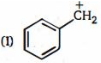
Which of the following options is the correct order of relative stabilities of cations $I, II$ and $III$ as written below (most stable first) ?

$(II)\,\,\,{{H}_{2}}C=CH-C{{H}_{2}}-\overset{+}{\mathop{C}}\,H-C{{H}_{3}}$

$(III)\,\,\,\begin{matrix}
   \,\,\,\,\,C{{H}_{3}}\,  \\
   |\,  \\
   {{H}_{3}}C-C-\overset{+}{\mathop{C}}\,{{H}_{2}}  \\
   |\,  \\
   \,\,\,C{{H}_{3}}  \\
\end{matrix}$
Which property of water is used while washing clothes?
Which of the following species have maximum number of unpaired electrons
The frequency of radiation emitted when the electron falls from $n = 4$ to $n = 1$ in a hydrogen atom will be (Given ionization energy of $H$ $ = 2.18 \times {10^{ - 18}}J\,\,\,{\rm{ato}}{{\rm{m}}^{ - 1}}$ and $h = 6.625 \times {10^{ - 34}}\,Js)$
The hydration enthalpies of alkali metal ions decrease with increase-in ionic size. Which of the following ions has maximum degree of hydration?