MCQ
Which is constant for a satellite in orbit
  • A
    Velocity
  • Angular momentum
  • C
    Potential energy
  • D
    Acceleration

Answer

Correct option: B.
Angular momentum
b
(b)Angular momentum is conserved in central field.

Need a full question paper?

Generate a complete, print-ready paper with questions like this in minutes — across 16+ boards, with answer keys.

Start Generating Free

Similar questions

For which one of the following, Bohr model in not valid $?$
To find the distance $d$ over which a signal can be seen clearly in foggy conditions, a railways engineer uses dimensional analysis and assumes that the distance depends on the mass density $\rho$ of the fog, intensity (power/area) $S$ of the light from the signal and its frequency $f$. The engineer find that $d$ is proportional to $S ^{1 / n}$. The value of $n$ is:
A metal surface is illuminated by a radiation of wavelength $4500 \; \mathring A$. The ejected photo-electron enters a constant magnetic field of $2 \; mT$ making an angle of $90^{\circ}$ with the magnetic field. If it starts revolving in a circular path of radius $2 \; mm$, the work function of the metal is approximately ............. $eV$
A body of mass 0.5 kg travels in a straight line with velocity $v = k x { }^{ 3 / 2 }$ where $k = 5 ~ m ^{-1 / 2} s ^{-1}$. The work done by the net force during its displacement from $x=0$ to $x=2 m$ is:
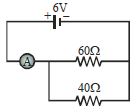
The measurement of ammeter in the following circuit is ................... $A$ (Assuming ideal ammeter)
In Millikan's oil drop experiment an oil drop carrying a charge $Q$ is held stationary by a potential difference $2400\,V$ between the plates. To keep a drop of half the radius stationary the potential difference had to be made $600\,V$. What is the charge on the second drop
If $L $ is the coherence length and $c$  the velocity of light, the coherent time is
Select the correct statement about electric charge
A body of mass $m $ accelerates uniformly from rest to ${v_1}$ in time ${t_1}$. As a function of time $ t$, the instantaneous power delivered to the body is
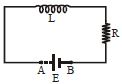
An inductor $(L = 100\, mH),$ a resistor $(R = 100 \, \Omega )$ and a battery $(E = 100 \,V)$ are initially connected in series as shown in the figure. After a long time the battery is disconnected after short circuiting the points $A$ and $B.$ The current in the circuit $1 \,ms$ after the short circuit is-