Question
Which is correct relation

Answer

(b)

Need a full question paper?

Generate a complete, print-ready paper with questions like this in minutes — across 16+ boards, with answer keys.

Start Generating Free

Similar questions

The root mean square speed of hydrogen molecules at $300$ $K$ is $1930\, m/s.$ Then the root mean square speed of oxygen molecules at $900\, K$ will be ....... $m/s$
Two planets $A$ and $B$ of radii $R$ and $1.5 R$ have densities $\rho$ and $\rho / 2$ respectively. The ratio of acceleration due to gravity at the surface of $B$ to $A$ is :
An isolated rail car of mass $M$ is moving along a straight, frictionless track at an initial speed $v_0$. The car is passing under a bridge when $a$ crate filled with $N$ bowling balls, each of mass $m$, is dropped from the bridge into the bed of the rail car. The crate splits open and the bowling balls bounce around inside the rail car, but none of them fall out. Is the momentum of the rail car $+$ bowling balls system conserved in this collision?
In an $ac$ circuit, the instantaneous voltage $e(t)$ and current $I(t)$ are given by $e(t)$ = $5[cos\ \omega t + \sqrt 3\ sin\ \omega t]\ volt$ $i (t)$ = $5[sin(\omega t +\frac {\pi}{4})]\ amp$ then
In a silicon transistor, a change of $7.89 mA$ is the emitter current produces a change of $7.8 mA$ in the collector current. What change in the base current is necessary to produce an equivalent change in the collector current is ..........$mA$
$c_P$ and $c_V$ are specific heats at constant pressure and constant volume respectively. It is observed that

$c_P - c_V = a$ for hydrogen gas

$c_P - c_V = b$ for nitrogen gas

The correct relation between $a$ and $b$ is
A boy playing on the roof of a $10\, m$ high building throws a ball with a speed of $10\,m/s$ at an angle of $30^o$ with the horizontal. How far from the throwing point will the ball be at the height of $10\, m$ from the ground ?  $\left[ {g = 10\,m/{s^2},\sin \,{{30}^o} = \frac{1}{2},\cos \,{{30}^o} = \frac{{\sqrt 3 }}{2}} \right]$
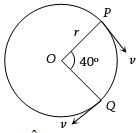
A particle is moving on a circular path of radius $r$ with uniform velocity $v$. The change in velocity when the particle moves from $P$ to $Q$ is $(\angle POQ = 40^\circ )$

      Column $-I$

    Angle of projection

    Column $-II$
  $A.$ $\theta \, = \,{45^o}$   $1.$ $\frac{{{K_h}}}{{{K_i}}} = \frac{1}{4}$
  $B.$ $\theta \, = \,{60^o}$   $2.$ $\frac{{g{T^2}}}{R} = 8$
  $C.$ $\theta \, = \,{30^o}$   $3.$ $\frac{R}{H} = 4\sqrt 3 $
  $D.$ $\theta \, = \,{\tan ^{ - 1}}\,4$   $4.$ $\frac{R}{H} = 4$

$K_i :$ initial kinetic energy

$K_h :$ kinetic energy at the highest point

Electrical conductivity of a semiconductor