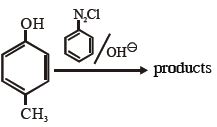
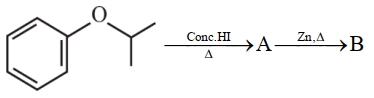
MCQ
Which is diamagnetic ?
- A$[Co(F)_6]^{3-}$
- ✓$[Ni(CN)_4]^{2-}$
- C$[NiCl_4]^{2-}$
- D$[Fe(CN)_6]^{3-}$
(a) [Fe(CN)6]3- Oxidation state of Fe=+3
It has one unpaired electron and is paramagnetic.
(b) It has two unpaired electrons and is paramagnetic
(c) It has no unpaired electron and is diamagnetic
(d) $\therefore$ It is paramagnetic as it has five unpaired electrons.
Generate a complete, print-ready paper with questions like this in minutes — across 16+ boards, with answer keys.
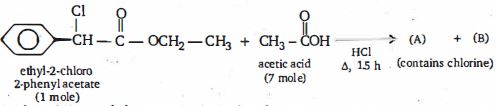
$2 H _2( g )+2 NO ( g ) \rightarrow N _2( g )+2 H _2 O ( g )$
which following the mechanism given below:
$2 NO ( g ) \underset{ k _{-1}}{\stackrel{ k _1}{\rightleftharpoons}} N _2 O _2( g )$
$N _2 O _2( g )+ H _2( g ) \stackrel{ k _2}{\rightleftharpoons} N _2 O ( g )+ H _2 O ( g )$
$N _2 O ( g )+ H _2( g ) \stackrel{ k _3}{\rightleftharpoons} N _2( g )+ H _2 O ( g )$
(fast equilibrium)
(slow reaction)
(fast reaction)
The order of the reaction is