MCQ
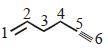
Which is incorrect numbering in the following compounds as per $IUPAC$ rules ?
- A
- B
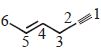
- C
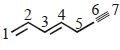
- ✓
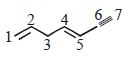
Generate a complete, print-ready paper with questions like this in minutes — across 16+ boards, with answer keys.

$[Image]$
The $y$ and $x$ axes for zero and first order reactions, respectively are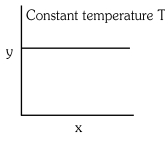
$Cu^{+2} +e^-\to Cu^+\,\,\,\,\,E^o = 0.15\,volt$
$Cu^{+2} + 2e^-\to Cu\,\,\,\,\,E^o = 0.34\, volt$
What will be the $E^o$ for half cell
$Cu^+ + e^-\to Cu$ ? ........... $\mathrm{volt}$
$\mathrm{M}\left|\mathrm{M}^{2+}\right||\mathrm{X}| \mathrm{X}^{2-}$
If $\mathrm{E}_{\left(\mathrm{M}^{2+} / \mathrm{M}\right)}^0=0.46 \mathrm{~V}$ and $\mathrm{E}_{\left(\mathrm{x} / \mathrm{X}^{2-}\right)}^0=0.34 \mathrm{~V}$.
Which of the following is correct?
Assertion $(A)$ : $\mathrm{NH}_3$ and $\mathrm{NF}_3$ molecule have pyramidal shape with a lone pair of electrons on nitrogen atom. The resultant dipole moment of $\mathrm{NH}_3$ is greater than that of $\mathrm{NF}_3$.
Reason $(R)$ : In $\mathrm{NH}_3$, the orbital dipole due to lone pair is in the same direction as the resultant dipole moment of the $\mathrm{N}-\mathrm{H}$ bonds. $\mathrm{F}$ is the most electronegative element.
In the light of the above statements, choose the correct answer from the options given below: