MCQ
Which is incorrect
- ✓$Ni (CO)_4 -$ Tetrahedral, Paramagnetic
- B$[Ni(CN)_4]^{-2} -$ Square planar, diamagnetic
- C$Ni(CO)_4 -$ Tetrahedral, diamagnetic
- D$[NiCl_4]^{-2} -$ Tetrahedral, Paramagnetic
Generate a complete, print-ready paper with questions like this in minutes — across 16+ boards, with answer keys.
$(A)\,\,CH_3CH_2CH_2Br + KOH \rightarrow CH_3CH CH_2 + KBr + H_2O$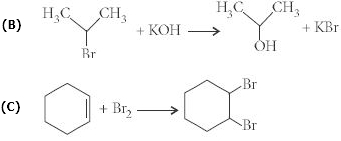
$(a)\;\left(\mathrm{CH}_{3}\right)_{3} \mathrm{CCH}(\mathrm{OH}) \mathrm{CH}_{3} \stackrel{\mathrm{conc.H}, \mathrm{SO}_{4}}{\longrightarrow}$
$(b)\;\left(\mathrm{CH}_{3}\right)_{2} \mathrm{CHCH}(\mathrm{Br}) \mathrm{CH}_{3} \stackrel{\text { alc.KOH }}{\longrightarrow}$
$(c)\;\left(\mathrm{CH}_{3}\right)_{2} \mathrm{CHCH}(\mathrm{Br}) \mathrm{CH}_{3} \xrightarrow[\text { It should be }\left(\mathrm{CH}_{3}\right)_{3} \mathrm{CO}^{-} \mathrm{K}^{+}]{\text { given by } \mathrm{NTA}\left(\mathrm{CH}_{3}\right)_{3} \mathrm{O}^{-} \mathrm{K}^{+}}$
$(d)\;\begin{array}{*{20}{c}}
{{{(C{H_3})}_2}C - C{H_2} - CHO} \\
{|\,\,\,\,\,\,\,\,\,\,\,\,\,\,\,\,\,\,} \\
{OH\,\,\,\,\,\,\,\,\,\,\,\,\,\,}
\end{array}\xrightarrow{\Delta }$
Which of these reaction(s) will not produce Saytzeff product ?
Assume Planck's constant $( h )=6.4 \times 10^{-34}\,Js$ Speed of light $( c )=3.0 \times 10^8\,m / s$ and Avogadro's constant $\left( N _{ A }\right)=6 \times 10^{23} / mol$
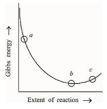
$A.$Reaction is spontaneous at $(a)$ and $(b)$
$B.$Reaction is at equilibrium at point $(b)$ and nonspontaneous at point $(c)$
$C.$Reaction is spontaneous at $(a)$ and nonspontaneous at $(c)$
$D.$Reaction is non-spontaneous at $(a)$ and $(b)$