MCQ
Which is incorrect
  • A
    In an isobaric process, $\Delta p = 0$
  • B
    In an isochoric process, $\Delta W = 0$
  • C
    In an isothermal process, $\Delta T = 0$
  • In an isothermal process, $\Delta Q = 0$

Answer

Correct option: D.
In an isothermal process, $\Delta Q = 0$
d
(d)In isothermal process $\Delta Q \ne 0.$

Need a full question paper?

Generate a complete, print-ready paper with questions like this in minutes — across 16+ boards, with answer keys.
Start Generating Free

Similar questions

What is the pressure on a swimmer $20 \,m$ below the surface of water ........ $atm$
For a satellite moving in an orbit around the earth, the ratio of kinetic energy to potential energy is
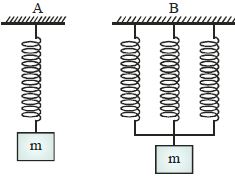
The springs in figure. $A$ and $B$ are identical but length in $A$ is three times that in $B$. The ratio of period $T_A/T_B$ is
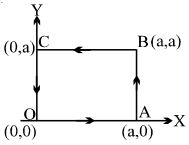
The work done by the force $\vec F\, = \,{x^2}\hat i\, + {y^2}\hat j$ around the path shown in the figure is
Thermoelectric thermometer is based on
A body of mass $m= 10^{-2}$ $kg$ is moving in a medium and experiences a frictional force $F= -kv^2$. Its initial speed is $v_0= 10$ $ms^{-1}$. If, after $10\; s$, its energy is $\frac{1}{8}$ $mv_0^2$ the value of $k$ will be
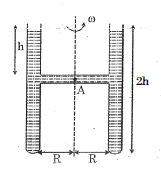
The shown $H$ shaped apparatus contains an ideal incompressible liquid and has dimension as shown in figure . The diameters of the Tubes  are small as  compared to $h$ and $R$. The apparatus is rotated with a constant angular velocity $\omega$  about a symmetric vertical axis as shown in figure. The pressure at point $A$ is
A glass plate is partly dipped vertically in the mercury and the angle of contact is measured. If the plate is inclined, then the angle of contact will
A bullet of mass $0.1\, kg$ is fired on a wooden block to pierce through it, but it stops after moving a distance of $50\, cm$ into it. If the velocity of bullet before hitting the wood is $10$ $m / s$ and it slows down with uniform deceleration, then the magnitude of effective retarding force on the bullet is $'x' N.$ The value of $'x'$ to the nearest integer is................. $N$
The coefficients of thermal expansion of steel and a metal $X$ are respectively $12 × 10^{-6}$ and $2 × 10^{-6} per^o C$. At $40^o C$, the side of a cube of metal $X$ was measured using a steel vernier callipers. The reading was $100 \,\,mm$.Assuming that the calibration of the vernier was done at $0^o C$, then the actual length of the side of the cube at $0^o C$ will be