Question
Which is more polar: $\mathrm{CO}_2$ or $\mathrm{N}_2 \mathrm{O}$? Give reason.

Answer

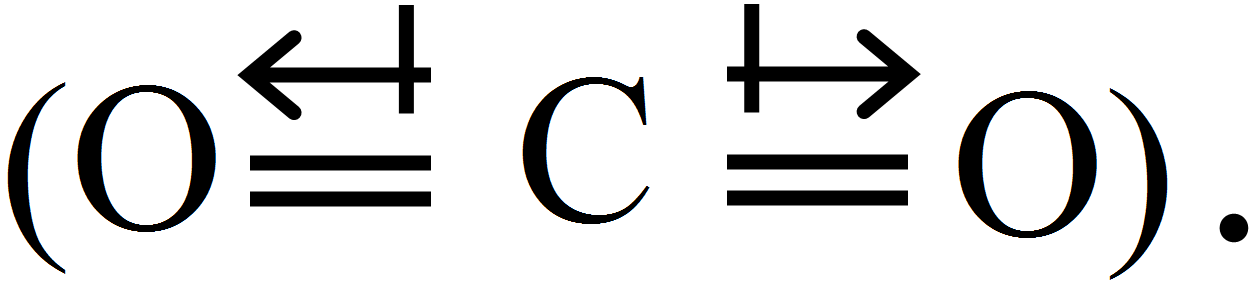
$\mathrm{N}_2 \mathrm{O}$ is more polar than $\mathrm{CO}_2$. This is because $\mathrm{CO}_2$​​​​​​​ is linear and symmetrical. Its net dipole moment is zero,

$\mathrm{N}_2 \mathrm{O}$ on the other hand, is linear but unsymmetrical. It is considered as a resonance hybrid of the following two structures.

It has a net dipole moment of 0.116D.

Need a full question paper?

Generate a complete, print-ready paper with questions like this in minutes — across 16+ boards, with answer keys.

Start Generating Free

Similar questions

If electron is revolving in the first Bohr orbital of a H -atom with a velocity $2.19 \times 10^8 \mathrm{~cm} / \mathrm{s}^{-1}$, what will velocity of electron in 3rd orbital of hydrogen atom.
What are non-benzanoid aromatic compounds? Explain with examples.
i. $\mathrm{Ca}_2$
ii. $\mathrm{CaC}_2$
iii. $\mathrm{H}_2 \mathrm{CO}_3$
iv. $HCN$
v. $CO$
How many electrons will be present in the subshells having ms value of $-\frac{1}{2}$ for $\mathrm{n}=4$ ?
Explain the following:
Aluminium forms $\left[\mathrm{AlF}_6\right]^{3-}$ ion but boron does not form $\left[\mathrm{BF}_6\right]^{3-}$ ion.
A gas occupies a volume of 250mL at 745mm of Hg and 25°C. What additional pressure is required to reduce the gas volume to 200mL at the same temperature?
The density of gas is $1.964 \mathrm{~g} \mathrm{~L}^{-1}$ at 273 K and 76 cm Hg . Calculate molar mass of the gas. $\left[\mathrm{R}=0.082 \mathrm{~L} \mathrm{~atm} \mathrm{~K}^{-1} \mathrm{~mol}^{-1}\right]$
Consider the following gas phase reaction:$\text{H}_{2}\text{(g)} + \text{Cl}_{2} \text{(g)} \rightleftharpoons\text{2HCl(g)}$
$\Delta\text{H}^{\circ} = -92\text{kJ}, \ \Delta\text{S}^{\circ} = -95\text{JK}^{-1}$
Calculate the equilibrium constant, $K_p$ at 298 K for this reaction.
Explain magnetic quantum number.
Complete the following reactions:
  1. $\text{CO}\text{(g)}+\text{H}_2(\text{aq})\xrightarrow[\text{Catalyst}\ ]{\Delta}$
  2. $\text{Ca}(\text{HCO}_3)_2(\text{s})+\text{Ca}(\text{OH})_2(\text{aq})\xrightarrow{\ \ \ \ \ \ \ }$