MCQ
Which is not a colligative property
  • Refractive index
  • B
    Lowering of vapour pressure
  • C
    Depression of freezing point
  • D
    Elevation of boiling point

Answer

Correct option: A.
Refractive index
a
Colligative properties depend on how many solute particles are present as well as the solvent amount, but they do NOT depend on the type of solute particles.

Hence, Refractive Index is not a colligative particles as it only depends on nature of materials.

Need a full question paper?

Generate a complete, print-ready paper with questions like this in minutes — across 16+ boards, with answer keys.

Start Generating Free

Similar questions

An example of a neutral oxide is
$1 \times 10^{-5}\,M \textrm {AgNO } _ { 3 }$ is added to $1\,L$ of saturated solution of $AgBr$. The conductivity of this solution at $298\,K$ is $.........\times 10^{-8}\,S\,m ^{-1}$

$\left[\right.$ Given : $K _{ sp }( AgBr )=4.9 \times 10^{-13}$ at $298 K$

$\lambda_{ Ag ^{+}}^0=6 \times 10^{-3} Sm ^2\,mol ^{-1}$

$\lambda_{ Br ^{-}}^0=8 \times 10^{-3} Sm ^2\,mol ^{-1}$

$\left.\lambda_{ NO _3^{-}}^0=7 \times 10^{-3} Sm ^2\,mol ^{-1}\right]$

Review the $SRP$ (at $25\,^oC$ ) data in acidic medium

$T{i^{4 + }} + e \to T{i^{3 + }},\,{E^o} =  - xV$,

$F{e^{3 + }} + e \to F{e^{2 + }},\,{E^o} =  - yV$,

$\{$ where $x < y$ point out the wrong statement
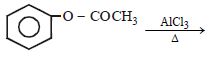
Maximum ferromagnetism is found in?
Which of the following compound will form $2^o -$ alcohol when treated with Grignard reagent followed by hydrolysis
The product obtained is/are
$\underbrace {\mathop {Hg{I_2}\,}\limits_{'X'} \xrightarrow[{Sublimation}]{\Delta }\,\mathop {Hg{I_2}}\limits_{'Y'} \xrightarrow{{Cooling}}\mathop {Hg{I_2}}\limits_{'Z'} }_{On\,\,rubbing}$
The $'f'$ orbitals are half and completely filled, respectively in lanthanide ions ....

(Given: Atomic no. $Eu, 63; Sm , 62 ; Tm , 69 ; Tb$, $65 ; Yb , 70 ; Dy , 66]$

Number of complexes with even number of electrons in $\mathrm{t}_{2 \mathrm{~g}}$ orbitals is -

${\left[\mathrm{Fe}\left(\mathrm{H}_2 \mathrm{O}\right)_6\right]^{2+},\left[\mathrm{Co}\left(\mathrm{H}_2 \mathrm{O}\right)_6\right]^{2+},\left[\mathrm{Co}\left(\mathrm{H}_2 \mathrm{O}\right)_6\right]^{3+},}$

${\left[\mathrm{Cu}\left(\mathrm{H}_2 \mathrm{O}\right)_6\right]^{2+},\left[\mathrm{Cr}\left(\mathrm{H}_2 \mathrm{O}\right)_6\right]^{2+}}$
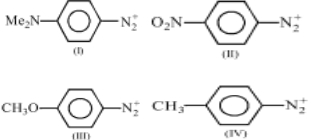
For the diazonium ions the order of reactivity towards the diazo-coupling with phenol in the presence of dilute $NaOH$ is: