MCQ
Which is not a physical quantity
  • A
    Volume
  • B
    Time
  • C
    Length
  • Mole

Answer

Correct option: D.
Mole
d
Mole is a unit and not the quantity

Need a full question paper?

Generate a complete, print-ready paper with questions like this in minutes — across 16+ boards, with answer keys.
Start Generating Free

Similar questions

Obtain the dimensional equation for universal gas constant.
Water rises to a height of $2\, cm$ in a capillary tube. If the tube is tilted $60^o$ from the  vertical, water will rise in the tube to a length ...... $cm$
The electrical conductivity of pure germanium can be increased by:
  1. Increasing the temperature.
  2. Doping acceptor impurities.
  3. Doping donor impurities.
  4. Irradiating ultraviolet light on it.
Two metallic wires $P$ and $Q$ have same volume and are made up of same material. If their area of cross sections are in the ratio $4: 1$ and force $F_1$ is applied to $\mathrm{P}$, an extension of $\Delta l$ is produced. The force which is required to produce same extension in $Q$ is $\mathrm{F}_2$.The value of $\frac{\mathrm{F}_1}{\mathrm{~F}_2}$ is__________.
A circular metallic ring of radius $R$ has a small gap of width $d$. The coefficient of thermal expansion of the metal is $\alpha$ in appropriate units. If we increase the temperature of the ring by an amount $\Delta T$, then width of the gap
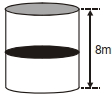
A thermally isolated cylindrical closed vessel of height $8 m$ is kept vertically. It is divided into two equal parts by a diathermic (perfect thermal conductor) frictionless partition of mass $8.3 kg$. Thus the partition is held initially at a distance of $4 m$ from the top, as shown in the schematic figure below. Each of the two parts of the vessel contains $0.1$ mole of an ideal gas at temperature $300 K$. The partition is now released and moves without any gas leaking from one part of the vessel to the other. When equilibrium is reached, the distance of the partition from the top (in $m$ ) will be. . . . . . (take the acceleration due to gravity $=10 ms ^{-2}$ and the universal gas constant $=8.3 J mol ^{-1} K ^{-1}$ ).
Four rods of identical cross-sectional area and made from the same metal form the sides of square. The temperature of two diagonally opposite points and $T$ and $\sqrt 2 $ $T$ respective in the steady state. Assuming that only heat conduction takes place, what will be the temperature difference between other two points
$A$ particle of mass $m$ is rotating in a plane is $a$ circular path of radius $r$, its angular momentum is $L$. The centripital force acting on the particle is :
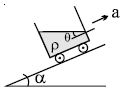
A fluid container is containing a liquid of density $\rho $ is accelerating upward with acceleration a along the inclined place of inclination $\alpha$  as shown. Then the angle of inclination $ \theta $ of free surface is :
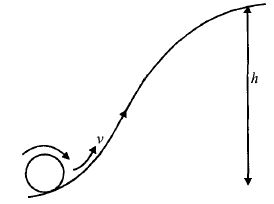
A solid sphere is rolling on a surface as shown in figure, with a translational velocity $v\,ms^{-1}$. If it is to climb the inclined surface continuing to roll without slipping, then minimum velocity for this to happen is