MCQ
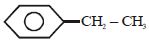
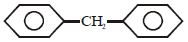
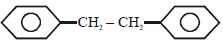
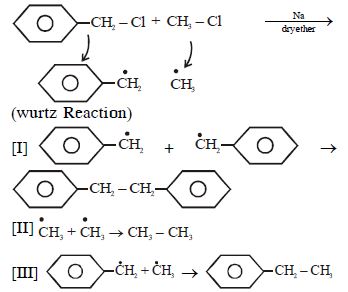
Which is not formed in the given reaction

  • A


  • C
    $CH_3 -CH_3$
  • D

Answer

Correct option: B.

b

Need a full question paper?

Generate a complete, print-ready paper with questions like this in minutes — across 16+ boards, with answer keys.

Start Generating Free

Similar questions

Which of the following are mixed anhydride?
Among the given pairs, in which pair second compound is more acidic than first ?
$30.4\,kJ$ of heat is required to melt one mole of sodium chloride and the entropy change at the melting point is $28.4\,J\,K ^{-1}\,mol ^{-1}$ at $1\,atm$. The melting point of sodium chloride is $...........K$ (Nearest Integer)
$50 \mathrm{~mL}$ of $0.2$ molal urea solution (density $=1.012 \mathrm{~g} \mathrm{~mL}^{-1}$ at $300 \mathrm{~K}$ ) is mixed with $250 \mathrm{~mL}$ of a solution containing $0.06 \mathrm{~g}$ of urea. Both the solutions were prepared in the same solvent. The osmotic pressure (in Torr) of the resulting solution at $300 \mathrm{~K}$ is . . . . .$\left.\Delta_{\operatorname{mix}} \mathrm{V}=0\right]$
Given below are two statements :

Statement $I :$ The identification of $Ni ^{2+}$ is carried out by dimethyl glyoxime in the presence of $NH _{4} OH$.

Statement $II :$ The dimethyl glyoxime is a bidentate neutral ligand.

In the light of the above statements, choose the correct answer from the options given below:

Alkyl halides can be converted into Grignard reagents by
Correct decreasing order of boiling point of given compounds
$I.\,HCl$          $II.\,\,H_2O$            $III.\,\,HF$              $IV.\,\,NH_3$
The formation of the oxide ion, ${O^{2 - }}\left( g \right)$, from oxygen atom requires first an exothermic and then an endothermic step as shown below

$O\left( g \right) + {e^ - } \to O_{\left( g \right)}^ - \,\,\,\,;\,\,\,\,{\Delta _f}{H^\Theta } =  - 141\,kJ\,mo{l^{ - 1}}$

${O^ - }\left( g \right) + {e^ - } \to O_{\left( g \right)}^{2 - }\,\,\,\,;\,\,\,\,{\Delta _f}{H^\Theta } =  + 780\,kJ\,mo{l^{ - 1}}$

Thus process of formation of $O_2^-$ in gas phase is unfavourable even thought $O_2^-$ is isoelectronic with neon. It is due to the fact that,

When electron jumps from $n = 5$ to $n = 2$ with all possible transitions then correct answer is
The rate constants $k_1$ and $k_2$ for two differentre actions are $10^{16} \cdot e^{-2000/T}$ and $ 10^{15} \cdot e^{-1000/T},$ respectively. The temperature at which $k_1 = k_2$ is