MCQ
Which is not primary amine ?
  • A
    Secondary butyl amine
  • B
    Tertiary butyl amine
  • $N-$ methyl ethanamine
  • D
    All of these

Answer

Correct option: C.
$N-$ methyl ethanamine
c

Need a full question paper?

Generate a complete, print-ready paper with questions like this in minutes — across 16+ boards, with answer keys.

Start Generating Free

Similar questions

Which of the following presents the correct order of second ionization enthalpies of $C, N, O$ and $F$ ?
For the first-order reaction $T_{av}$ (average life), $T_{50}$ and $T_{75}$ in the increasing order are
A $20\, litre$ container at $400\, K$ contains $CO_{2(g)}$ at pressure $0.4\, atm$ and an excess of $SrO$ (neglect the volume of solid $SrO$). The volume of the container is now decreased by movingthe movable piston fitted in the container. The maximum volume of the container, when pressure of $CO_2$ attains its maximum value, will be........$litre$

(Given that : $SrCO_{3(s)} \rightleftharpoons  SrO_{(s)}+ CO_{2(g)} \,, K_p=1.6\,atm$)

$KClO _3+6 FeSO _4+3 H _2 SO _4 \rightarrow KCl +3 Fe _2\left( SO _4\right)_3+3 H _2 O$ The above reaction was studied at $300\,K$ by monitoring the concentration of $FeSO _4$ in which initial concentration was $10\,M$ and after half an hour became $8.8\,M$. The rate of production of $Fe _2\left( SO _4\right)_3$ is $........\times 10^{-6}\,mol\,L ^{-1}\,s ^{-1}$.
$Ph - C \equiv CH\xrightarrow[{\left( {Excess} \right)}]{{HCl}}X\xrightarrow{{KOH\left( {aq.} \right)}}Y\xrightarrow{{C{H_3} - C{H_2}}}Z,$

$Z$ is known as

The molality of a $10 \%( v / v )$ solution of di-bromine solution in $CCl _4$ (carbon tetrachloride) is $x$. $x=$ $......\times 10^{-2}\,M$. (Nearest integer)

[Given : molar mass of $Br _2=160\,g\,mol ^{-1}$

atomic mass of $C =12\,g\,mol ^{-1}$

atomic mass of $Cl =35.5\,g\,mol ^{-1}$

density of dibromine $=3.2\,g\,cm ^{-3}$

density of $\left.CCl _4=1.6\,g\,cm ^{-3}\right]$
Opticaly inactive amino acid is ?
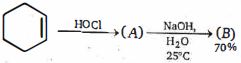
Correct statement about above reaction is
A hydrocarbon of formula ${C_6}{H_{10}}$ absorbs only one molecule of ${H_2}$ upon catalytic hydrogenation. Upon ozonolysis, the hydrocarbon yields $\begin{array}{*{20}{c}}
  {\,H\,\,\,\,\,\,\,\,\,\,\,\,\,\,\,\,\,\,\,\,\,\,\,\,\,\,\,\,\,\,\,\,\,\,\,\,\,\,\,\,\,\,\,\,\,\,\,\,\,\,\,\,\,\,\,\,\,\,\,\,\,\,\,\,\,\,\,\,\,\,\,\,\,\,\,\,\,\,\,\,\,\,\,\,H} \\ 
  {|\,\,\,\,\,\,\,\,\,\,\,\,\,\,\,\,\,\,\,\,\,\,\,\,\,\,\,\,\,\,\,\,\,\,\,\,\,\,\,\,\,\,\,\,\,\,\,\,\,\,\,\,\,\,\,\,\,\,\,\,\,\,\,\,\,\,\,\,\,\,\,\,\,\,\,\,\,\,\,\,\,\,\,\,\,\,\,|} \\ 
  {O = C - C{H_2} - C{H_2} - C{H_2} - C{H_2} - C = O} 
\end{array}$ The hydrocarbon is
In ammonium-phosphomolybdate, the oxidation state of Mo is ${ }^{+}$ $..........$.