MCQ
Which is not true for transition elements
- AThey are all metals
- BThey show variable valency
- CThey form coloured ions
- ✓They do not form co-ordinate compounds
$(i)$ High nuclear charge
$(ii)$ Small size
$(iii)$ Vacant $d-$ orbital
Generate a complete, print-ready paper with questions like this in minutes — across 16+ boards, with answer keys.
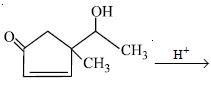
${C_6}{H_5}CHO + C{H_3} - CHO\xrightarrow{{\mathop O\limits^\Theta H}}$ Product
will be
$\mathrm{CH}_{3} \mathrm{COOH}+\mathrm{SOCl}_{2} \longrightarrow \mathrm{A} \xrightarrow[AlCl_3]{Benzene} \mathrm{B} \xrightarrow[-OH]{KCN} \mathrm{C}$
$Z{n^{2 + }}\,(aq)\, + \,2e\, \rightleftharpoons \,Zn\,(s)\,;\, - \,0.762\,V$
$C{r^{3 + }}\,(aq)\, + \,3e\, \rightleftharpoons \,Cr(s)\,;\, - \,0.740\,\,V$
$2{H^ + }\,(aq)\, + \,2e\, \rightleftharpoons \,{H_2}(g)\,;\,\,\,0.00\,\,\,V$
$F{e^{3 + }}\,(aq)\, + \,e\, \rightleftharpoons \,F{e^{2 + }}(aq)\,;\,\,\,0.770\,\,\,V$
Which is the strongest reducing agent ?
$2NO_2(g) + O_3(g) \to N_2O_5(g) + O_2(g)$
rate law is $R = K\, [NO_2]' [O_3]'$.
Which of these possible reaction mechanisms is consistent with the rate law?
Mechanism $I :$
$NO_2(g) + O_3(g) \to NO_3(g) + O_2(g)$ (slow)
$NO_3(g) + NO_2(g) \to N_2O_5(g)$ (fast)
Mechanism $II :$
$O_3(g) \rightleftharpoons O_2(g) + [O]$ (fast)
$NO_2(g) + [O] \to NO_3$ (slow)
$NO_3(g) + NO_2(g) \to N_2O_5$ (fast)