MCQ
Which is the best reducing agent
  • A
    ${F^ - }$
  • B
    $C{l^ - }$
  • C
    $B{r^ - }$
  • ${I^ - }$

Answer

Correct option: D.
${I^ - }$
d
Strongest reducing agent among the halide ions is $I ^{\ominus}$. Tendency to lose electrons and reducing power are directly related to each other. Large sized iodide ion has maximum tendency to lose electrons and has maximum reducing power.

Need a full question paper?

Generate a complete, print-ready paper with questions like this in minutes — across 16+ boards, with answer keys.

Start Generating Free

Similar questions

Which of the following are not state functions?

$(I)\,\,q + \mathrm{w}$           $(II)\,\, q$

$(III)\,\, \mathrm{w}$              $(IV)\,\, H - TS$

The increasing order of the reactivity of the following halides for the $S_N1$ reaction is

$(I)\,\begin{array}{*{20}{c}}
  {C{H_3}CHC{H_2}C{H_3}} \\ 
  {|\,\,\,\,\,\,\,\,\,\,\,} \\ 
  {Cl\,\,\,\,\,\,\,\,\,} 
\end{array}$

$(II)\,CH_3CH_2CH_2Cl$

$(III)\,H_3CO-C_6H_4-CH_2Cl$

In the molecule $CH_3C \equiv CCH = CH_2$ the maximum number of carbon atoms arranged linearly is
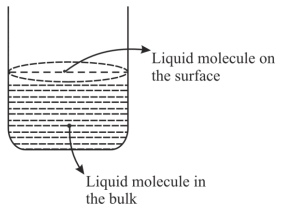
Based on the given figure, the number of correct statement/s is/are $........$.

$A.$ Surface tension is the outcome of equal attractive and repulsion forces acting on the liquid molecule in bulk.

$B.$ Surface tension is due to uneven forces acting on the molecules present on the surface.

$C.$ The molecule in the bulk can never come to the liquid surface.

$D.$ The molecules on the surface are responsible for vapour pressure if the system is a closed system.
Van't Hoff factor of $Hg_2Cl_2$ in its aqueous solution will be : ($Hg_2Cl_2$ is $80\%$ ionized in the solution) :-
The Spin only magnetic moment value of square planar complex $\left[\mathrm{Pt}\left(\mathrm{NH}_3\right)_2 \mathrm{Cl}\left(\mathrm{NH}_2 \mathrm{CH}_3\right)\right] \mathrm{Cl}$ is $B.M.$ (Nearest integer) (Given atomic number for $\mathrm{Pt}=78$ 
Which compound forms linear polymer due to $H-$ bond
Which of the following element has the lowest ionization potential
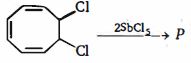
$p$ will be
For the reaction $(1)$ and $(2)$ :
$A \rightleftharpoons  B + C ....(1)$
$D \rightleftharpoons  2E ....(2)$
Given $K_{P_1} : K_{P_2} : : 9 : 1$
If the degree dissociation of $A$ and $D$ be same then the total pressure at equilibria $(1)$ and $(2)$ are in the ratio (Assume reaction are started with equal number of moles of $A$ and $D$).