MCQ
Which is the correct expression for half-life
  • A
    ${(t)_{1/2}} = \log \,2$
  • B
    ${(t)_{1/2}} = \frac{\lambda }{{\log \,2}}$
  • C
    ${(t)_{1/2}} = \frac{\lambda }{{\log \,{\rm{2}}}}(\,2.303)$
  • ${(t)_{1/2}} = \frac{{2.303\,{\rm{ log\,2}}}}{\lambda }$

Answer

Correct option: D.
${(t)_{1/2}} = \frac{{2.303\,{\rm{ log\,2}}}}{\lambda }$
d
(d)${T_{1/2}} = \frac{{{{\log }_e}\,2}}{\lambda } = \frac{{2.303\,{{\log }_{10}}\,2\,}}{\lambda }$

Need a full question paper?

Generate a complete, print-ready paper with questions like this in minutes — across 16+ boards, with answer keys.
Start Generating Free

Similar questions

The angle of dip at the magnetic equator is
Which of the following statement is true
Radio wave diffract around building although light waves do not. The reason is that radio waves
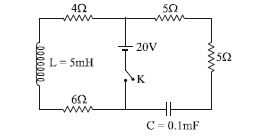
In the circuit shown, the key $(k)$ is closed at $t = 0$ , the current through the key at the instant $t = 10\,-\,3ln\,2\, sec$ . is.......$Amp$
The induction coil works on the principle of
At a certain place, the horizontal component of earth's magnetic field is $\sqrt 3 $times the vertical component. The angle of dip at that place is....$^o$
When the electromagnetic radiations of frequencies $4 \times 10^{15} \,Hz$ and $6 \times 10^{15} \,Hz$ fall on the same metal in different experiments, the ratio of maximum kinetic energy of electrons liberated is $1: 3$. The threshold frequency for the metal is ............... $\times 10^{15} Hz$
A current-carrying, straight wire is kept along the axis of a circular loop carrying a current. The straight wire:
Given below are two statements : one is labelled as Assertion $A$ and the other is labelled as Reason $R$.

Assertion $A :$ For a simple microscope, the angular size of the object equals the angular size of the image.

Reason $R$ : Magnification is achieved as the small object can be kept much closer to the eye than $25\, cm$ and hence it subtends a large angle.

In the light of the above statements, choose the most appropriate answer from the options given below:

A wire of length 1 m is moving at a speed of $2 \mathrm{~ms}^{-1}$perpendicular to its length and a homogeneous magnetic field of 0.5 T. The ends of the wire are joined to a circuit of resistance 6 W. The rate at which work is being done to keep the wire moving at constant speed is