MCQ
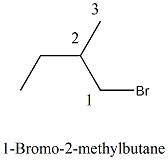
Which is the correct $IUPAC $ name for :

$\begin{array}{*{20}{c}}
{C{H_3} - CH - C{H_2} - Br}\\
{|\,\,\,\,\,\,\,\,\,\,\,\,\,\,\,\,}\\
{{C_2}{H_5}\,\,\,\,\,\,\,\,\,}
\end{array}$

  • A
    $1$ -boromo- $2$ -ethylpropane
  • B
    $1$ -bromo- $2$ -ethyl- $2$ -methylethane
  • $1$ -bromo- $2$ -methylbutane
  • D
    $2$ -methyl- $1$ -bromobutane

Answer

Correct option: C.
$1$ -bromo- $2$ -methylbutane
c
Numbering should start at the substituent carbon and longest chain should be covered.

$1$- Bromo-$2$-methylbutane

Need a full question paper?

Generate a complete, print-ready paper with questions like this in minutes — across 16+ boards, with answer keys.

Start Generating Free

Similar questions

The reaction is called $\begin{array}{*{20}{c}}
  {2C{H_3} - C - O{C_2}{H_5}} \\ 
  {||\,\,\,} \\ 
  {O\,\,\,} 
\end{array}$ ${\xrightarrow{{{C_2}{H_5}ONa}}}$  $\begin{array}{*{20}{c}}
  {C{H_3} - C - C{H_2} - C - O{C_2}{H_5}} \\ 
  {||\,\,\,\,\,\,\,\,\,\,\,\,\,\,\,\,\,\,\,\,\,\,\,\,\,\,\,||\,\,\,\,\,\,\,} \\ 
  {O\,\,\,\,\,\,\,\,\,\,\,\,\,\,\,\,\,\,\,\,\,\,\,\,\,\,O\,\,\,\,\,} 
\end{array}$ $ + \,{C_2}{H_5}OH$
Which of the following does not show geometrical isomerism ?
Which of the following is anhydride of perchloric acid
The number of electrons in the nucleus of ${C^{12}}$ is
When a mixture of ethanol and methanol is heated in the presence of concentrated ${H_2}S{O_4}$ the resulting organic product or products is/are
In electrophilic substitution reaction nitrobenzene is
A $6.50$ molal solution of $KOH$ $(aq.)$ has a density of $1.89\, g\, cm ^{-3}$. The molarity of the solution is .......... $mol\, dm ^{-3} .$

(Round off to the Nearest Integer).

[Atomic masses: $K : 39.0\, u ; O : 16.0 \,u ; H : 1.0\, u ]$

The oxidation state of chromium in the final product formed by the reaction between $KI$  and acidified potassium dichromate solution is
Which of the following have maximum electron gain enthalpy
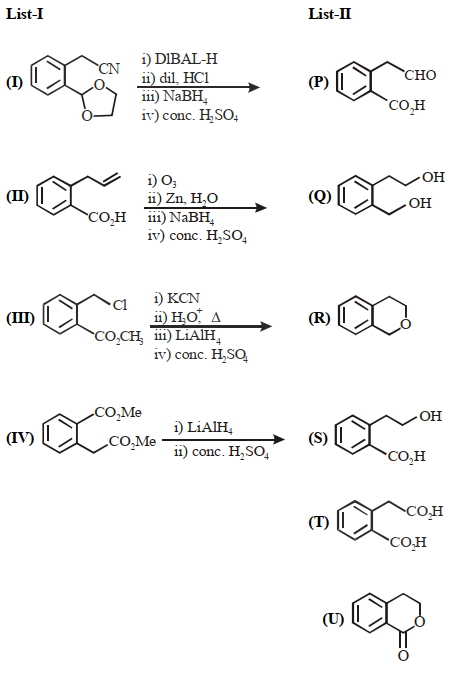
Answer the following by appropriately matching the lists based on the information given in the paragraph $List-I$ includess starting materials and reagents of selected chemical reactions. $List-II$ gives structures of compounds that may be formed as intermediate products and/or final products from the reactions of $List-I$

($1$) Which of the following options has correct combination considering $List-I$ and $List-II$?

$(1) (III), (S), (R)$ $(2) (IV), (Q), (R)$ $(3) (III), (T), (U)$ $(4) (IV), (Q), (U)$

($2$) Which of the following options has correct combination considering $List-I$ and $List-II$?

$(1) (I), (Q), (T), (U)$ $(2) (II), (P), (S), (U)$ $(3) (II), (P), (S), (T)$ $(4) (I), (S), (Q), (R)$

Give the answer quetion ($1$) and ($2$)