MCQ
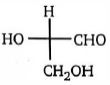
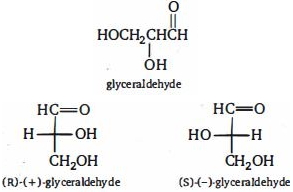
Which is the correct structure of $D$ -glyceraldehyde ?
  • A

  • B

  • C

  • All of these

Answer

Correct option: D.
All of these
d
$(d)$ The smallest aldose and the only one whose name does not end in "ose," is
glyceraldehyde, an aldotriose.

Because glyceraldehyde has a chirality center, it can exist as a pair of  enantiomers.                      
Need a full question paper?

Generate a complete, print-ready paper with questions like this in minutes — across 16+ boards, with answer keys.

Start Generating Free

Similar questions

The following reaction is known as

Phenol $\xrightarrow[{{H^ + }}]{{{\text{CHC}}{{\text{l}}_3}{\text{ /NaOH}}}}$ Salicyladehyde

$\Delta {G^o}$ for the reaction $X + Y$  $\rightleftharpoons$ $ Z$  is $ -4.606 \,kcal$ . The value of equilibrium constant of the reaction at ${227\,^o}C$ is $(R = 2.0\,cal.\,mo{l^{ - 1}}{K^{ - 1}})$
Which of the following oxide not form acidic aqueous solution
Statement $I :$ Acid strength increases in the order given as $\mathrm{HF}<\mathrm{HCl}<<\mathrm{HBr}<<\mathrm{HI}$

Statement $II :$ As the size of the elements $\mathrm{F}, \mathrm{Cl}, \mathrm{Br}, \mathrm{I}$ increases down the group, the bond strength of $\mathrm{HF}$, HCl, HBr and HI decreases and so the acid strength increases.

In the light of the above statements, choose the correct answer from the options given below.

Nitrobenzene combines with hydrogen in the presence of platinum to produce
The total number of intensive properties from the following is $........$.

Volume, Molar heat capacity, Molarity, $E ^\theta$ cell, Gibbs free energy change, Molar mass, Mole

Which of the following equations correctly represents the standard heat of formation $(\Delta H_f^o)$ of methane
$n - Butane \xrightarrow{{C{l_2}/hv}}$

Give the total number of monochloro products(including stereo isomers), which  are possible in the above reaction.

Insulin is a protein which plays the role of
The $\mathrm{pH}$ of a solution obtained by mixing $50 \,\mathrm{~mL}$ of $1\, \mathrm{M}\, \mathrm{HCl}$ and $30 \,\mathrm{~mL}$ of $1\, \mathrm{M} \,\mathrm{NaOH}$ is $\mathrm{x} \times 10^{-4}$. The value of $\mathrm{x}$ is ...... . (Nearest integer) $[\log 2.5=0.3979]$