MCQ
Which is the most explosive
  • $NC{l_3}$
  • B
    $PC{l_3}$
  • C
    $AsC{l_3}$
  • D
    All of these

Answer

Correct option: A.
$NC{l_3}$
a
(a) $NC{l_3}$ is highly reactive and unstable. Hence it is explosive.

Need a full question paper?

Generate a complete, print-ready paper with questions like this in minutes — across 16+ boards, with answer keys.

Start Generating Free

Similar questions

An unknown chlorohydrocarbon has $3.55\%$ of chlorine. If each molecule of the hydrocarbon has one chlorine atom only, chlorine atoms present in  $1\,g$ of chlorohydrocarbon are (Atomic wt. of $Cl = 35.5\,u;$  Avogadro constant  $= 6.023 \times 10^{23}\,mol^{- 1}$ )
Which of the following compounds represents acrylonitrile
Which of following is amphoteric
In the given reaction $\begin{array}{*{20}{c}}
  {{C_6}{H_5} - C - C{H_3}} \\ 
  {||} \\ 
  O 
\end{array}$ $\xrightarrow{{N{H_2}OH/{H^ \oplus }}}X\xrightarrow{{Na/{C_2}{H_5}OH}}Y$. $Y$will be
Molar mass of the hydrocarbon $(X)$ which on ozonolysis consumes one mole of $O _3$ per mole of $( X )$ and gives one mole each of ethanal and propanone is $......g\,mol ^{-1}$ (Molar mass of $C : 12\,g\,mol ^{-1}, H : 1\,g\,mol ^{-1}$ )
Compound $(B)$ is
$MeO$ The compound $(X)$ is
The formation of the oxide ion, ${O^{2 - }}\left( g \right)$, from oxygen atom requires first an exothermic and then an endothermic step as shown below

$O\left( g \right) + {e^ - } \to O_{\left( g \right)}^ - \,\,\,\,;\,\,\,\,{\Delta _f}{H^\Theta } =  - 141\,kJ\,mo{l^{ - 1}}$

${O^ - }\left( g \right) + {e^ - } \to O_{\left( g \right)}^{2 - }\,\,\,\,;\,\,\,\,{\Delta _f}{H^\Theta } =  + 780\,kJ\,mo{l^{ - 1}}$

Thus process of formation of $O_2^-$ in gas phase is unfavourable even thought $O_2^-$ is isoelectronic with neon. It is due to the fact that,
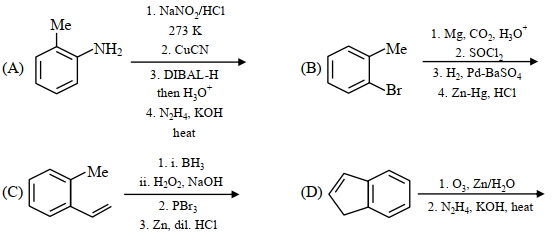
The correct order of increasing $s$ -character (in percentage) in the hybrid orbitals of following molecules ions is :-
$(I)$ $CO_3^{2-}$                  $(II)$ $XeF_4$
$(III)$ $I_3^-$                       $(IV)$ $NCl_3$
$(V)$ $BeCl_2$
The reaction sequence($s$) that would lead to $o$-xylene as the major product is (are)