MCQ
Which is the most reactive hydrocarbon in the following
  • A
    Ethane
  • Ethyne
  • C
    Ethene
  • D
    Methane

Answer

Correct option: B.
Ethyne
b
(b)Alkyne > Alkene > Alkane

Need a full question paper?

Generate a complete, print-ready paper with questions like this in minutes — across 16+ boards, with answer keys.

Start Generating Free

Similar questions

Exactly $1\,g$ of urea dissolved in $75\,g$ of water gives a solution that boils at $100.114\,^oC$ at $760\,torr$. The molecular weight of urea is $60.1$. The boiling point elevation constant for water is
Correct order of base strength in benzene as a solvent for given amines is

$\underset{I}{\mathop{C{{H}_{3}}-C{{H}_{2}}-N{{H}_{2}}}}\,$ 

$\underset{II}{\mathop{{{(C{{H}_{3}}C{{H}_{2}})}_{2}}NH}}\,$ 

$\mathop {{{(C{H_3}C{H_2})}_3}N}\limits_{II} $

Primary, secondary and tertiary amines can be separated using :-
Data given for the following reaction is as follows:

$\mathrm{FeO}_{(0)}+\mathrm{C}_{\text {(gaplike) }} \longrightarrow \mathrm{Fe}_{(0)}+\mathrm{CO}_{(\mathrm{g})}$

Substance

$\Delta \mathrm{H}^{\circ}$

$\left(\mathrm{kJ} \mathrm{mol}^{-1}\right)$

$\Delta \mathrm{S}^{\circ}$

$\left(\mathrm{J} \mathrm{mol}^{-1} \mathrm{~K}^{-1}\right)$

$\mathrm{FeO}_{(s)}$ $-266.3$ $57.49$
$\mathrm{C}_{\text {(graphite) }}$ $0$ $5.74$
$\mathrm{Fe}_{(s)}$ $0$ $27.28$
$\mathrm{CO}_{(\mathrm{g})}$ $-110.5$ $197.6$

The minimum temperature in $\mathrm{K}$ at which the reaction becomes spontaneous is ....... .

(Integer answer)

$'A'$ and $'B'$ in the following reactions are ${image}$
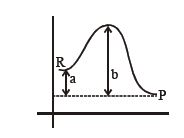
The energy diagram for a reaction $R \to P$ is shown as below $\Delta {H^o}$ for the reaction will be
Phenol $(C_6H_6O)$ $\xrightarrow{{B{r_2}\,\,in\,\,C{S_2}}}$ $X$ (Major product)

Phenol $(C_6H_6O)$ $\xrightarrow{{B{r_2}\,\,in\,\,H_2{O}}}$ $Y$ (Major product)

What is  $X$  and  $Y$  in above reaction respectively

Which of the following is the strongest conjugate base
benzen + $CH_3-CH_2-CH_2-Cl$ $\xrightarrow{{AlC{l_3}}}$ the product
Two $5$ molal solutions are prepared by dissolving a non-electrolyte, non-volatile solute separately in the solvents $X$ and $Y$. The molecular weights of the solvents are $M_X$ and $M_Y$, respectively where $M_X\, = \frac{3}{4} M_Y$. The relative lowering of  vapour pressure of the solution in $X$ is $''m''$ times that of the solution in $Y$. Given that the number of moles of solute is very small in comparison to that of solvent, the value of $''m''$  is