MCQ
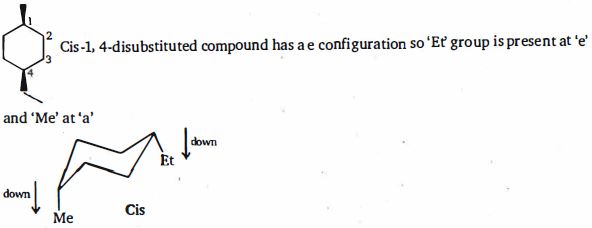
Which is the most stable chair form of this compound ?

- A

- ✓

- C

- D

Generate a complete, print-ready paper with questions like this in minutes — across 16+ boards, with answer keys.
For the given reaction, if the initial pressure is $450\,mm Hg$ and the pressure at time $t$ is $720\,mm\,Hg$ at a constant temperature $T$ and constant volume $V$. The fraction of $A ( g )$ decomposed under these conditions is $x \times 10^{-1}$. The value of $x$ is $......$.(nearest integer)
| Compound | Weight $\%$ of $P$ | Weight $\%$ of $Q$ |
| $1$ | $50$ | $50$ |
| $2$ | $44.4$ | $55.6$ |
| $3$ | $40$ | $60$ |
$(A)$ If empirical formula of compound $3$ is $P_3 Q_4$, then the empirical formula of compound $2$ is $P_3 Q_5$.
$(B)$ If empirical formula of compound $3$ is $P _3 Q _2$ and atomic weight of element $P$ is $20$ , then the atomic weight of $Q$ is $45$ .
$(C)$ If empirical formula of compound $2$ is $PQ$, then the empirical formula of the compound $1$ is $P _5 Q _4$.
$(D)$ If atomic weight of $P$ and $Q$ are $70$ and $35$ , respectively, then the empirical formula of compound $1$ is $P _2 Q$.
$X \rightleftharpoons 2Y$ and $Z \rightleftharpoons P + Q,$
respectively are in the ratio of $1 : 4.$ If the degree of dissociation of $X$ is $2$ times that of $Z,$ then the ratio of total pressure $(P_1 : P_2)$ at these equilibria is : (Assume degree of dissociation for both reactions are very very small)