MCQ
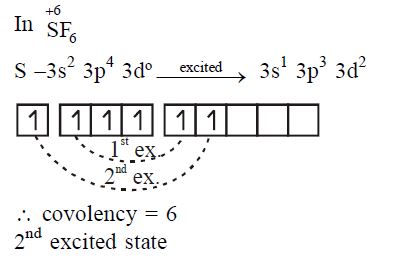
Which is true for $SF_6$
  • A
    $S$ : ground state, covalency $= 6$
  • B
    $S$ : excited state, covalency $= 4$
  • $S$ : excited state, oxidation No $= + 6$
  • D
    $S$ : ground state, oxidation No. $= + 6$
Answer

Correct option: C.
$S$ : excited state, oxidation No $= + 6$
c

Need a full question paper?

Generate a complete, print-ready paper with questions like this in minutes — across 16+ boards, with answer keys.

Start Generating Free

Similar questions

Which of the following elements does not show allotropy ?
The boiling point of water in a $0.1$ molal silver nitrate solution (solution $A$ ) is $x ^{\circ} C$. To this solution A, an equal volume of $0.1$ molal aqueous barium chloride solution is added to make a new solution $B$. The difference in the boiling points of water in the two solutions $A$ and $B$ is $y \times 10^{-2}{ }^{\circ} C$.

(Assume : Densities of the solutions $A$ and $B$ are the same as that of water and the soluble salts dissociate completely.)

Use: Molal elevation constant (Ebullioscopic Constant), $K _{ b }=0.5 K kg mol ^{-1}$; Boiling point of pure water as $100^{\circ} C$.)

($1$) The value of $x$ is

($2$) The value of $|y|$ is
$0.6\,g$ of a solute is dissolved in $0.1\,litre$ of a solvent which develops an osmotic pressure of $ 1.23\,atm$ at ${27\,^o}C$. The molecular mass of the substance is ........ $g\,mol{e^{ - 1}}$
A neutral fertilizer among the following compounds is
Among $Co ^{3+}, Ti ^{2+}, V ^{2+}$ and $Cr ^{2+}$ ions, one if used as a reagent cannot liberate $H _{2}$ from dilute mineral acid solution, its spin-only magnetic moment in gaseous state is $......B.M$. (Nearest integer)
Which disaccharide is present in milk?
In a transition series, as the atomic number increases, paramagnetism
The ultimate product of oxidation of most of hydrogen and carbon in foodstuffs are
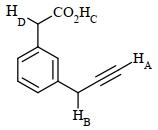
What is the correct order of acidity of the protons marked $A-D$ in the given compounds?
The concentration of potassium ions inside a biological cell is at least twenty times higher than the outside. The resulting potential difference across the cell is important in several processes such as transmission of nerve impulses and maintaining the ion balance. A simple model for such a concentration cell involving a metal $\mathrm{M}$ is:

$\mathrm{M}(\mathrm{s}) \mid \mathrm{M}^{+}$(aq; $0.05$ molar) || $\mathrm{M}^{+}(\mathrm{aq}), 1$ molar) $\mid \mathrm{M}(\mathrm{s})$

For the above electrolytic cell the magnitude of the cell potential $\left|E_{\text {cell }}\right|=70 \mathrm{mV}$.

$1.$ For the above cell

$(A)$ $\mathrm{E}_{\text {cell }}<0 ; \Delta \mathrm{G}>0$ $(B)$ $\mathrm{E}_{\text {cell }}>0 ; \Delta \mathrm{G}<0$

$(C)$ $\mathrm{E}_{\text {cell }}<0 ; \Delta \mathrm{G}^{\circ}>0$ $(D)$ $\mathrm{E}_{\text {cell }}>0 ; \Delta \mathrm{G}^{\circ}>0$

$2.$ If the $0.05$ molar solution of $\mathrm{M}^{+}$is replaced by $0.0025$ molar $\mathrm{M}^{+}$solution, then the magnitude of the cell potential would be

$(A)$ $35 \mathrm{mV}$ $(B)$ $70 \mathrm{mV}$ $(C)$ $140 \mathrm{mV}$ $(D)$ $700 \mathrm{mV}$

Give the answer question $1,2.$