MCQ
Which is wrong about complex $[HgI_3]^{-1}$
  • A
    trigonal planer shape
  • B
    $sp^2$ hybridisation
  • Diamagnetic
  • D
    Both $A$ and $B$

Answer

Correct option: C.
Diamagnetic
c

Need a full question paper?

Generate a complete, print-ready paper with questions like this in minutes — across 16+ boards, with answer keys.

Start Generating Free

Similar questions

Two substances P and Q when brought together, form substance R with the evolution of heat. The properties of R are different from both P and Q. What is substance R?
$3 \;g$ of acetic acid is added to $250\; \mathrm{mL}$ of $0.1\; \mathrm{M} \mathrm{HCl}$ and the solution made up to $500\; \mathrm{mL}$ To $20 \;\mathrm{mL}$ of this solution $\frac{1}{2}\; \mathrm{mL}$ of $5\; \mathrm{M\;NaOH}$ is added. The $\mathrm{pH}$ of the solution is [Given : $\mathrm{pK}_{\mathrm{a}}$ of acetic acid $=4.75,$ molar mass of acetic acid $=60 \mathrm{g} / \mathrm{mol}, \log 3=0.4771]$

Neglect any changes in volume

Which of the following would not give $2-$ phenylbutane as the major product in a Friedel- Crafts alkylation reaction ?
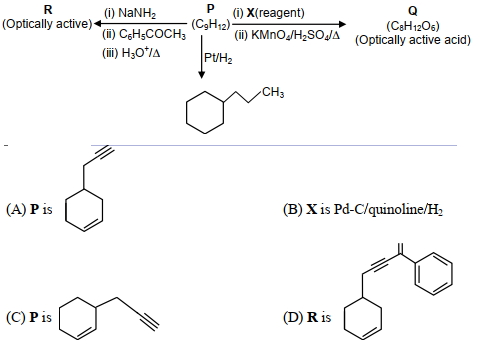
Consider the following transformations of a compound $P$.

(image)

Choose the correct option($s$).

(image)
If the difference in electronegativities of two elements is very large, then
The value of screening constant for an electron in $3s-$ orbital is always identical with that of an $e^-$ present in
$\mathop {C{H_2}}\limits_{(I)}  = O \leftrightarrow \mathop {{}^ \oplus C{H_2}}\limits_{(II)}  - {O^\circleddash } \leftrightarrow \mathop {{}^\circleddash C{H_2}}\limits_{(III)}  - {O^ \oplus }$

Which of these structures is practically not a valid canonical structure for formaldehyde ?

What products are formed when the following compound is treated with $Br_2$ in the presence of $FeBr_3$ ?
At $527\,^oC$ the reaction given below has $K_c= 4$

$N{H_3}(g)\, \rightleftharpoons \,\frac{1}{2}{N_2}(g)\, + \,\frac{3}{2}{H_2}(g)$

What is the $K_P$ for following reaction ?

$\,\,{N_2}(g)\, + \,3{H_2}(g) \rightleftharpoons 2N{H_3}(g)$

A reversible chemical reaction having two reactants in equilibrium. If the concentrations of the reactants are doubled, then the equilibrium constant will