Question
Which $L$ -sugar on oxidation gives an optically active dibasic acid
As only $(a)$ and $(d)$ are $L$-sugar, $(b)$ and $(c)$ are $D$-sugar after oxidation.
$(a)$ (Refer to Image $1$)
As the product do not superimpose in its mirror image.
$(d)$ (Refer to Image $2$)
As it has plane of symmetry.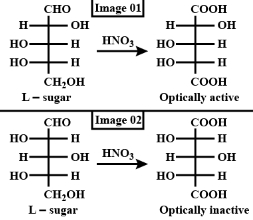
Generate a complete, print-ready paper with questions like this in minutes — across 16+ boards, with answer keys.

$\begin{array}{*{20}{c}}
{C{H_2} - COOH} \\
{|\,\,\,\,\,\,\,\,\,\,\,\,\,\,\,\,\,\,\,\,\,\,\,\,\,\,\,\,\,\,\,\,} \\
{C{H_2} - COOH}
\end{array}\xrightarrow{\Delta }(A)\xrightarrow{{C{H_3} - C{H_2}N{H_2}/\Delta }}(B)$
$(B)$ will be :