MCQ
Which $L$ -sugar on oxidation gives an optically active dibasic acid
- ✓
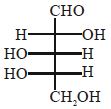
- B
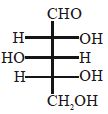
- C
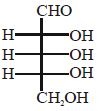
- D
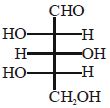
As only $(a)$ and $(d)$ are $L$-sugar, $(b)$ and $(c)$ are $D$-sugar after oxidation.
$(a)$ (Refer to Image $1$)
As the product do not superimpose in its mirror image.
$(d)$ (Refer to Image $2$)
As it has plane of symmetry.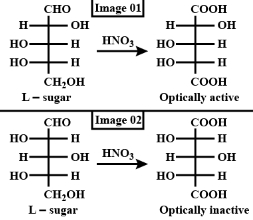
Generate a complete, print-ready paper with questions like this in minutes — across 16+ boards, with answer keys.
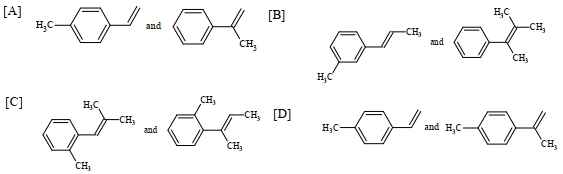
($i$) $P \xrightarrow[\text { ii) } \mathrm{Zn} / \mathrm{H}_2 \mathrm{O}]{\text { i) } \mathrm{O}_3 / \mathrm{CH}_2 \mathrm{Cl}_2} \underset{\left(\mathrm{C}_8 \mathrm{H}_8 \mathrm{O}\right)}{Q}$
($ii$) $R \xrightarrow[\text { ii) } \mathrm{Zn} / \mathrm{H}_2 \mathrm{O}]{\text { i) } \mathrm{O}_3 / \mathrm{CH}_2 \mathrm{Cl}_2} \underset{\left(\mathrm{C}_8 \mathrm{H}_8 \mathrm{O}\right)}{S}$
The option(s) with suitable combination of $P$ and $R$, respectively, is(are)