MCQ
Which law can ampere’s circuital be derived from?
- AGauss Law
- BNewton’s Law
- CKirchhoff’s Law
- DBiot-Savart Law
Explanation:
In classical electrodynamics, the magnetic field given by a current loop and the electric field caused by the corresponding dipoles in sheets are very similar, as far as we are far away from the loop, which enables us to deduce Ampere’s magnetic circuital law from the Biot-Savart law easily.
Generate a complete, print-ready paper with questions like this in minutes — across 16+ boards, with answer keys.
In a parabola spectrograph, the velocities of four positive ions P,Q,R and S are v1, v2, v3 and v4 respectively
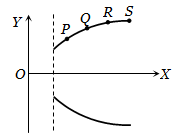
|
(a) |
(b) |
|
(c) |
(d) |
Three equal resistances each of value R are joined as shown in the figure. The equivalent resistance between M and N is
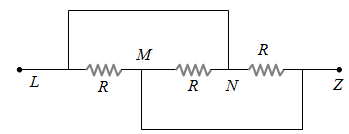
|
(a) R |
(b) 2R |
(c) |
(d) |
If in compound microscope m1 and m2 be the linear magnification of the objective lens and eye lens respectively, then magnifying power of the compound microscope will be
(a) 
|
(b) 
|
(c) |
(d) |
In an electroplating experiment, m gm of silver is deposited when 4 ampere of current flows for 2 minute. The amount (in gm) of silver deposited by 6 ampere of current for 40 second will be
|
(a) 4 m |
(b) m/2 |
(c) m/4 |
(d) 2 m |
A spectral line λ = 5000 Å in the light coming from a distant star is observed as a 5200 Å. What will be recession velocity of the star
|
(a) 1.15 |
(b) 1.15 |
(c) 1.15 |
(d) 1.15 km/sec |
For measurement of potential difference, potentiometer is preferred in comparison to voltmeter because
|
(a) Potentiometer is more sensitive than voltmeter |
|
(b) The resistance of potentiometer is less than voltmeter |
|
(c) Potentiometer is cheaper than voltmeter |
|
(d) Potentiometer does not take current from the circuit |
A wire carrying a current i is placed in a uniform magnetic field in the form of the curve y = asin 0 ≤ x ≤ 2L. The force acting on the wire is

|
(a) |
(b) iBL |
(c) 2iBL |
(d) Zero |