MCQ
Which match is not incorrect ?
  • A
    $CsI_3 \Rightarrow C{s^ + },3{I^ - }$
  • B
    $TiC{l_3} \Rightarrow T{l ^{ + 1}},Cl _3^ - $
  • C
    ${\text{GaC}}{{\text{l}}_3} \Rightarrow G{a^{ + 1}},Cl_3^ - $
  • ${\text{InC}}{{\text{l}}_3} \Rightarrow \operatorname{I} {n^{ + 3}},3C{l^ - }$
Answer

Correct option: D.
${\text{InC}}{{\text{l}}_3} \Rightarrow \operatorname{I} {n^{ + 3}},3C{l^ - }$
d

Need a full question paper?

Generate a complete, print-ready paper with questions like this in minutes — across 16+ boards, with answer keys.

Start Generating Free

Similar questions

The mass of $CO_2$ that will be obtained by heating $10\, kg$ of $80\%$ pure lime stone $(CaCO_3)$ is ............... $\mathrm{kg}$
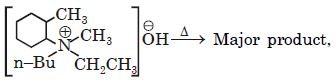
major product is :-
Which of the following is the correct plot for the probability density $\psi^{2}( r )$ as a function of distance ' $r$ ' of the electron form the nucleus for $2 s$ orbital?
When $AlCl_3·6H_2O$ is strongly heated, then it forms
Lead pipes are not suitable for drinking water because
Fats, on alkaline hydrolysis, gives
The correct order of increasing energy of atomic orbitals is
How many pairs of enantiomers are possible for following complex compound, $[M \,(AB)\, (CD) \,ef]^{n\,±}$ (where $AB,\,CD-$ Unsymmetrical bidentate ligand, $e$, $f-$ monodentate ligands)
The statement$(s)$ that are correct about the species $\mathrm{O}^{2-}, \mathrm{F}^{-}, \mathrm{Na}^{+}$and $\mathrm{Mg}^{2+}$.

$(A)$ All are isoelectronic

$(B)$ All have the same nuclear charge

$(C)$ $\mathrm{O}^{2-}$ has the largest ionic radii

$(D)$ $\mathrm{Mg}^{2+}$ has the smallest ionic radii

Choose the most appropriate answer from the options given below :

The following data is given for reaction between $A$ and $B$

$S.NO.$  $[A]$    $mol.L^{-1}$  $[B]$    $mol.L^{-1}$ $Rate$    $mol.L^{-1}\,sec^{-1}$
$I$ $1 \times 10^{-2}$ $2 \times 10^{-2}$ $2 \times 10^{-4}$
$II$ $2 \times 10^{-2}$ $2 \times 10^{-2}$ $4 \times 10^{-4}$
$III$ $2 \times 10^{-2}$ $4 \times 10^{-2}$ $8 \times 10^{-4}$ 

  Which of the following are correct statements -

$(a)$  Rate constant of the reaction $10^{-4}$

$(b)$  Rate law of the reaction is $k[A][B]$

$(c)$  Rate of reaction increases four times on doubling the concentration of both the reactant