MCQ
Which molecule/ ion out of the following does not contain unpaired electrons.
  • A
    $\text{N}^{+}_{2}$
  • $\text{O}_{2}$
  • C
    $\text{O}^{2-}_{2}$
  • D
    $\text{B}_{2}$

Answer

Correct option: B.
$\text{O}_{2}$
$\text{N}_{2}^{+}=\text{KK}\ \sigma\ 2\text{S}^{2}\sigma^{\star}\ 2\text{S}^{2}\pi2\text{p}_{\text{x}}=\pi\ 2\text{p}^{\text{2}}\sigma\ 2\text{P}_{\text{z}}$
$\text{O}_{2}=\text{KK}\ \sigma\ 2\text{S}^{2}\sigma^{\star}\ 2\text{S}^{2}\pi\ 2\text{p}_{\text{x}}=\pi\ 2\text{p}^{\text{2}}\pi\ 2\text{P}_{\text{z}}=\pi^{\star}\ 2\text{p}_{\text{y}}$
$\text{O}_{2}^{2-}=\text{KK}\ \sigma\ 2\text{S}^{2}\sigma^{\star}\ 2\text{S}^{2}\pi\ 2\text{p}_{\text{x}}=\pi\ 2\text{p}^{\text{2}}\pi\ 2\text{P}_{\text{z}}=\pi^{\star}\ 2\text{p}_{\text{y}}$
$\text{B}_{2}=\text{KK}\ \sigma\ 2\text{S}^{2}\sigma^{\star}\ 2\text{S}^{2}\pi\ 2\text{p}_{\text{x}}=\pi\ 2\text{p}_{\text{y}}$

Need a full question paper?

Generate a complete, print-ready paper with questions like this in minutes — across 16+ boards, with answer keys.

Start Generating Free

Similar questions

Few statements are given regarding nodes in the orbitals. Mark the statement which is not correct.
How many double bond equivalents does a compound of molecular formula $C_6H_{12}O_6$ possess?
Given below are two statements :

Statement $I$ : The electronegativity of group $14$ elements from $\mathrm{Si}$ to $\mathrm{Pb}$ gradually decreases.

Statement $II$ : Group $14$ contains non-metallic, metallic, as well as metalloid elements.

In the light of the above statements, choose the most appropriate from the options given below :
Order of the bond strength of $C-H$ bonds involving $sp, sp^2$ and $sp^3$ hybridized carbon atoms is
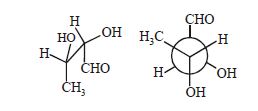
What is the relation between given compounds
Predict the correct intermediate, and product in the following reaction $\text{H}_3\text{C}-\text{C}\equiv\text{CH}\xrightarrow[\text{HgSO}_4]{\text{H}_2\text{O},\text{ H}_2\text{SO}_4}\text{intermediate}\rightarrow\text{product}\\ \ \ \ \ \ \ \ \ \ \ \ \ \ \ \ \ \ \ \ \ \ \ \ \ \ \ \ \ \ \ \ \ \ \ \ \ \ \ \ \ \ \ \ \ \ \ \ \ \ \ \ \ \ \text{'A'}\ \ \ \ \ \ \ \ \ \ \ \ \ \ \ \ \ \ \ \ \text{'B'}$
The heat evolved in the combustion of benzene is given by${C_6}{H_6} + 7\frac{1}{2}{O_2} \to 6C{O_2}(g) + 3{H_2}O(l);\,\Delta H = - 3264.6\,kJ$ Which of the following quantities of heat energy will be evolved when $39\,g\,{C_6}{H_6}$ are burnt.......$kJ$
Benzene reacts with $C{H_3}COCl$ in the presence of $AlC{l_3}$ to give
A solution of sodium chloride in contact with atmosphere has a $pH$ of about
The ozone layer 'ozonosphere' occurs in :