MCQ
Which molecule is linear
  • A
    $N{O_2}$
  • B
    $Cl{O_2}$
  • $C{O_2}$
  • D
    ${H_2}S$

Answer

Correct option: C.
$C{O_2}$
(c) $C{O_2}$ has $sp \,-$ hybridization and is linear.

Need a full question paper?

Generate a complete, print-ready paper with questions like this in minutes — across 16+ boards, with answer keys.
Start Generating Free

Similar questions

Assertion : $RCOCl, (RCO)_2O$ and $RCOOR$’ all react with Grignard reagents to form $3^o$ alcohols.
Reason : $RCOCl$ reacts with $R_2Cd$ to form ketones but $(RCO)_2O$ and $RCOOR'$ do not react at all.
An organic compound containing $C, H$ and $N$ gave following analysis : $C = 40\%$, $H = 13.33\%$ and $N = 46.67\%$. Its empirical formula would be
Arrange the following compounds in increasing order of their dipole moment :
$HBr , H _2 S, NF _3$ and $CHCl _3$
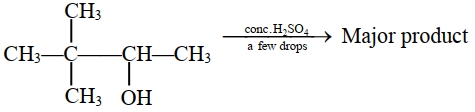
The major product formed in the following reaction is :
Which one of the following is a different pair?
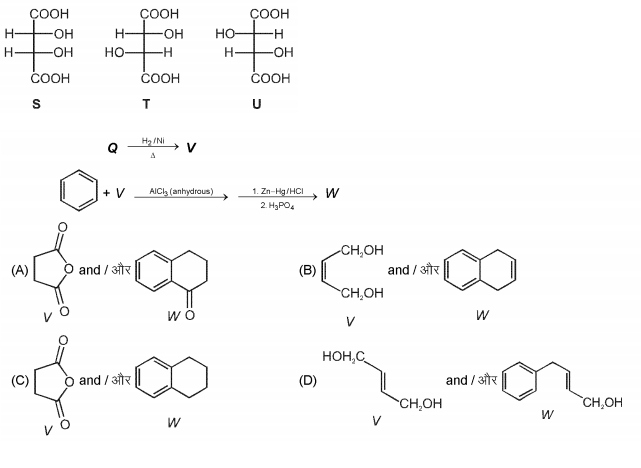
$P$ and $Q$ are isomers of dicarboxylic acid $C _4 H _4 O _4$. Both decolorize $Br _2 / H _2 O$. On heating, $P$ forms the cyclic anhydride.

Upon treatment with dilute alkaline $KMnO _4, P$ as well as $Q$ could produce one or more than one from $S , T$ and $U$.$Image$

$1.$ Compounds formed form $P$ and $Q$ are, respectively

$(A)$ Optically active $S$ and optically active pair $(T, U)$

$(B)$ Optically inactive $S$ and optically inactive pair $(T, U)$

$(C)$ Optically active pair $(T, U)$ and optically active $S$

$(D)$ Optically inactive pair $(T, U)$ and optically inactive $S$

$2.$ In the following reaction sequences $V$ and $W$ are respectively :$Image$

mcq $Image$

Give the answer question $1$ and $2.$
The energy of the electron in the first orbit of $He^+$ is $-871.6 \times 10^{-20}\, J$. The energy of the electron in the first orbit of hydrogen would be
Which of the following compound is amphoteric
Invalid name of given compound
The osmotic pressure of a $5\%$ $(w/V)$ solution of cane sugar at $150\,^oC$ will be ....... $atm.$