Question
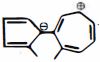
Which of following compound will rotate the plane polarized light at room temperature?
Answer

b
both rings are perpendicular to each other, so plane of symmetry and centre of symmetry is absent.

Need a full question paper?

Generate a complete, print-ready paper with questions like this in minutes — across 16+ boards, with answer keys.

Start Generating Free

Similar questions

Four species are listed below :

$i\,\, HCO_3$      $ii. \,H_3O^+$

$iii.\, HSO_4^-$       $iv.\, HSO_3F$

Which one of the following is the correct sequence of their acid strength?
Water is oxidised to oxygen by
In a catalytic conversion of ${N_2}$ to $N{H_3}$ by Haber's process, the rate of reaction was expressed as change in the concentration of ammonia per time is $40 \times {10^{ - 3}}\,mol\,litr{e^{ - 1}}{s^{ - 1}}$. If there are no side reaction, the rate of the reaction as expressed in terms of hydrogen is (in mol $litr{e^{ - 1}}{s^{ - 1}}$)
The $IUPAC$ name of given compound is :
Which does not form complex
In the following sets of reactants which two sets best exhibit the amphoteric characters of $Al_2O_3. xH_2O$ ?

Set $1$: $Al_2O_3 .xH_2O\, (s)$ and $OH^-(aq)$

Set $2$: $Al_2O_3 .xH_2O\, (s)$ and $H_2O\,(l)$

Set $3$: $Al_2O_3 .xH_2O\, (s)$ and $H^+(aq)$

Set $4$: $Al_2O_3 .xH_2O\, (s)$ and $NH_3(aq)$

The ionic radii of $O _{2}- F ^{-}, Na ^{+}$ and $Mg ^{2+}$ are in the order :
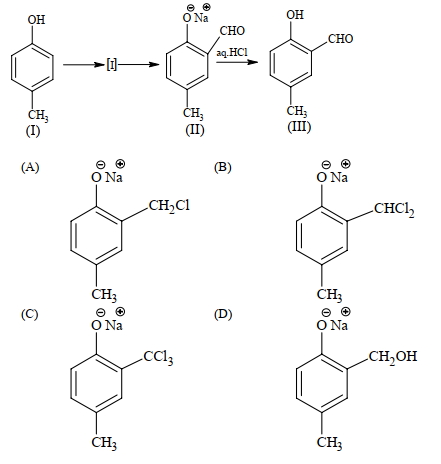
Reimer-Tiemann reaction introduces an aldehyde group, on to the aromatic ring of phenol, ortho to the hydroxyl group. This reaction involves electrophilic aromatic substitution. This is a general method for the synthesis of substituted salicyladehydes as depicted below.

$Image$

$1.$ Which one of the following reagents is used in the above reaction?

$(A)$ aq. $\mathrm{NaOH}+\mathrm{CH}_3 \mathrm{Cl}$

$(B)$ aq. $\mathrm{NaOH}+\mathrm{CH}_2 \mathrm{Cl}_2$

$(C)$ aq. $\mathrm{NaOH}+\mathrm{CHCl}_3$

$(D)$ aq. $\mathrm{NaOH}+\mathrm{CCl}_4$

$2.$ The electrophile in this reaction is

$(A)$ : $\mathrm{CHCl}$ $(B)$ ${ }^{+} \mathrm{CHCl}_2$

$(C)$ $\mathrm{CCl}_2$ $(D)$. $\mathrm{CCl}_3$

$3.$ The structure of the intermediate $I$ is

$Image$

Give the answer question $1, 2$ and $3.$
The degree of hydrolysis in hydrolytic equilibrum ${A^ - } + {H_2}O$ $\rightleftharpoons$ $HA + O{H^ - }$ at salt concentration of $0.001 \,\,M$ is $\left( {{K_a} = 1 \times {{10}^{ - 5}}} \right)$
Which of the following parameters is never affected by using a catalyst during a reaction?