MCQ
Which of following does not react with $HNO_2$ ?
  • A

  • B

  • C


Answer

Correct option: D.

d

Need a full question paper?

Generate a complete, print-ready paper with questions like this in minutes — across 16+ boards, with answer keys.

Start Generating Free

Similar questions

For a reaction, activation energy $\mathrm{E}_{\mathrm{a}}=0$ and the rate constant at $200\; \mathrm{K}$ is $1.6 \times 10^{6} \;\mathrm{s}^{-1} .$ The rate constant at $400\; \mathrm{K}$ will be glven that gas constant]

$\mathrm{R}=8.314\; \mathrm{JK}^{-1} \mathrm{mol}^{-1}$
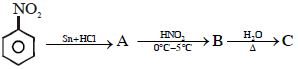
Identify product $C$ in above reaction sequence
What product will be formed from Hoffmann exhaustive methylation of following compound? 

$Me_2CHCH_2NHCH_2CH_2Me $ $\xrightarrow[\begin{smallmatrix} 
 (ii)\,A{{g}_{2}}O \\ 
 (iii)\,\Delta  
\end{smallmatrix}]{(i)\,C{{H}_{3}}-I(excess)}$ Product

Magnetic moment of $x^{n+}$ is $\sqrt {24} $ $B.M.$ Hence No. of unpaired electron and value of $'n'$ respectively. (Atomic number $= 26$)
Which one of the following oxides is expected exhibit paramagnetic behaviour
Osmotic pressure of a solution containing $ 0.1\,mole$ of solute per litre at $273\,K$ is (in atm)
The compound $A$ with following sequence of reaction gave benzoic acid.

$A\xrightarrow{NaN{{O}_{2}}/HCl}B\xrightarrow{KCN}C\xrightarrow{{{H}_{3}}{{O}^{+}}}$  benzoic acid

The compound $ A$ is

In which pair of ions both are diamagnetic in nature?
The mechanism of the reaction $A + 2B \to D$ is

$2B\xrightarrow{k}{B_2}$        [Slow]

${B_2} + A \to D$          [Fast]

The rate law expression, order with respect to $A$, order with respect to $'B'$ and overall order are respectively

Which of the following compounds will not undergo Cannizaro reaction, when  treated. with $50\%$ aqueous alkali?