MCQ
Which of following has highest $EA$
- A$F^-$
- B$Cl^-$
- ✓$Li^+$
- D$Na^+$
Generate a complete, print-ready paper with questions like this in minutes — across 16+ boards, with answer keys.
| $I.E.\, (kJ \,mol^{-1})$ | $I.E.\, (kJ\, mol^{-1})$ |
| $A_{(g)} \to A^+_{(g)}+e^-,$ $A_1$ | $B_{(g)} \to B^{+}_{(g)}+e^-,$ $B_1$ |
| $B^+_{(g)} \to B^{2+}_{(g)}+e^-,$ $B_2$ | $C_{(g)} \to C^{+}_{(g)}+e^-,$ $C_1$ |
| $C^+_{(g)} \to C^{2+}_{(g)}+e^-,$ $C_2$ | $C^{2+}_{(g)} \to C^{3+}_{(g)}+e^-,$ $C_3$ |
If monovalent positive ion of $A,$ divalent positive ion of $B$ and trivalent positive ion of $C$ have zero electron. Then incorrect order of corresponding $I.E.$ is
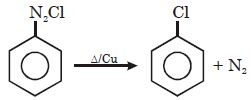
Half-life does not depend on the concentration of the reactant. After $10 \,\min,$ volume of $N_2$ gas is $20\, L$ and after the completion of reaction, it is $100\, L$. Hence, rate constant is :-