MCQ
Which of one is correct
  • ${E^2} = {p^2}{c^2}$
  • B
    ${E^2} = {p^2}c$
  • C
    ${E^2} = p{c^2}$
  • D
    ${E^2} = {p^2}/{c^2}$

Answer

Correct option: A.
${E^2} = {p^2}{c^2}$
a
(a) Momentum $p = \frac{E}{c}\, \Rightarrow \,{E^2} = {p^2}{c^2}$

Need a full question paper?

Generate a complete, print-ready paper with questions like this in minutes — across 16+ boards, with answer keys.

Start Generating Free

Similar questions

Which of the following is correct?
An e.m.f. of 12 volts is induced in a given coil when the current in it changes at the rate of 48 amperes per minute. The self inductance of the coil is
If in a nuclear fission, piece of uranium of mass $0.5\, g$ is lost, the energy obtained in $kWh$ is
Assertion : On going away from a point charge or a small electric dipole, electric field decreases at the same rate in both the cases.
Reason : Electric field is inversely proportional to square of distance from the charge or an electric dipole.
$X-$ rays and gamma rays are both electromagnetic waves. Which of the following statements is true
Assertion : A white source of light during interference forms only white and black fringes.

Reason : Width of fringe is inversely proportional to the wavelength of the light used.
A rod of length $l$ rotates with a uniform angular velocity $\omega $ about an axis passing through its middle point but normal to its length in a uniform magnetic field of induction $B$ with its direction parallel to the axis of rotation. The induced $emf$ between the two ends of the rod is
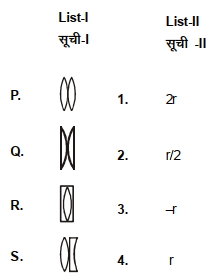
Four combinations of two thin lenses are given in List-$I$. The radius of curvature of all curved surface is r and the refractive index of all lenses is $1.5.$ Match lens combinations in List-$I$ with their focal length in List-$II$ and select the correct answer using the code given below the lists.
Light is incident from a medium into air at two possible angles of incidence $(A)\, 20^o$ and $(B)\, 40^o$ . In the medium light travels $3.0\, cm$ in $0.2\, ns$. The ray will
In an $LR$ -circuit, time constant is that time in which current grows from zero to the value (where ${I_0}$ is the steady state current)