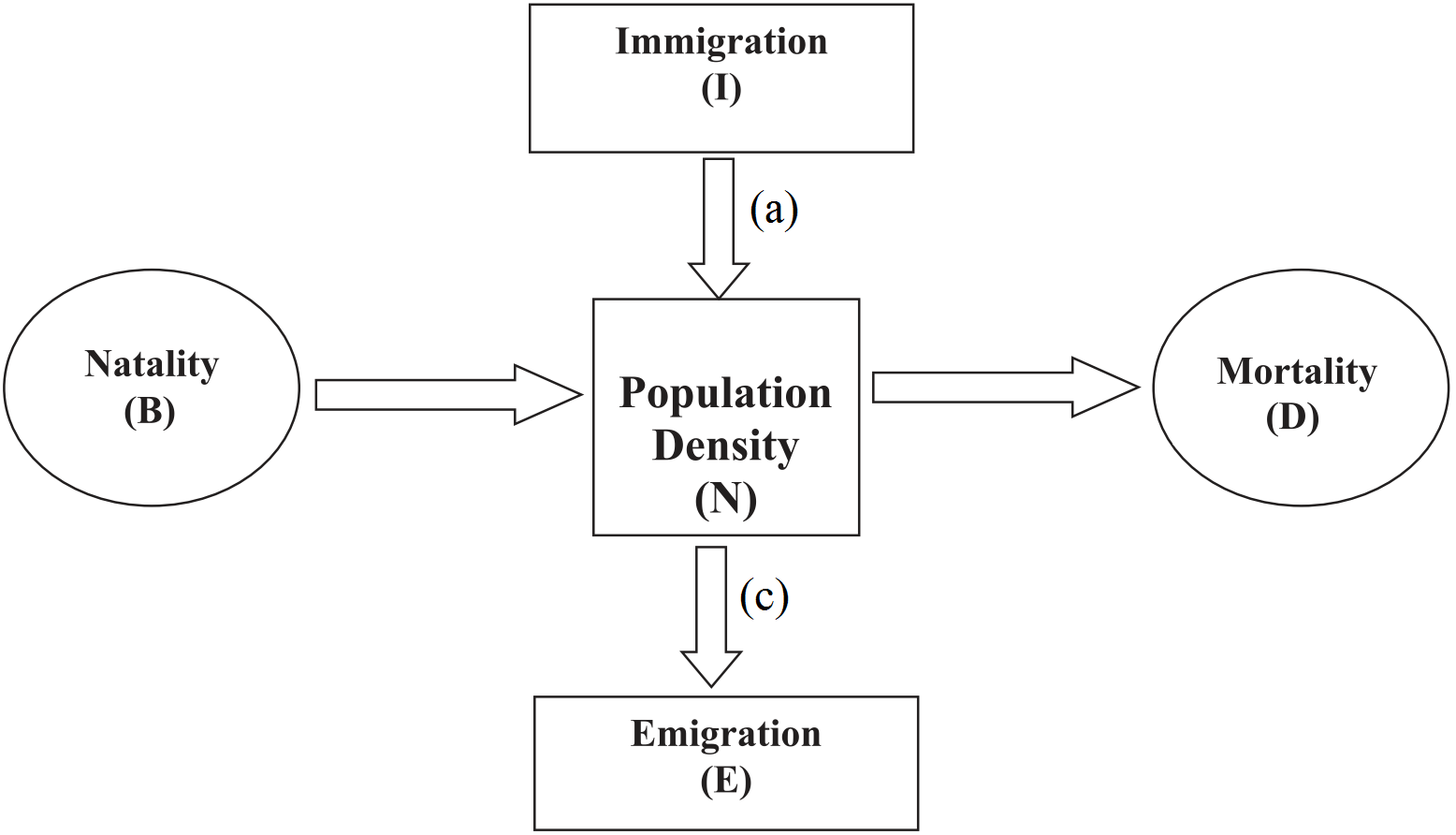
Question

  1. Which of the above represents the increase or decrease of population?
  2. If N is the population density at time t, then what would be its density at time (t + 1)? Give the formula.
  3. In a barn there were 30 rats. 5 more rats enter the barn and 6 out of the total rats were eaten by the cats. If 8 rats were born during the time period under consideration and 7 rats left the barn, find out the resultant population at time (t + 1).
  4. If a new habitat is just being colonized, out of the four factors affecting the population growth, which factor contributes the most?

Answer

  1. a and d represents increase of population and b and c represent decrease of population.
  2. Nt+1 = Nt + [(B + I) - (D + E)]
  3. Here, Nt = 30;

I = 5; E = 7;

D = 6;

B = 8

Putting the value in Nt + 1

= Nt + [(B + I) - (D + E)] Nt + 1

= 30 + [(8 + 5) - (6 + 7)]

= 30 + [13 - 13]

= 30 + 0

= 30 rats.

  1. Immigration contributes the most.

Need a full question paper?

Generate a complete, print-ready paper with questions like this in minutes — across 16+ boards, with answer keys.

Start Generating Free

Similar questions

Read the following and answer any four questions from (i) to (v) given below:

Plants having foreign genes in their genome through genetic engineering are called transgenic plants. Genes can be incorporated either through a vector or through direct introduction of DNA. Bt cotton is a genetically modified organism which is pest resistant. It contain gene cry I Ac and cry II Ab of Bacillus thuringiensis. It is used to control lepidopterans, coleopterans and dipterans. Bt cotton can resist cotton bollworm and produce higher yields. Cry gene produces cry protein or Bt toxin. It is an endotoxin which remains as protoxin in plants and converted to active toxin after getting ingested by the insects. Alkaline pH of the insect gut solubilises the protein crystals, the activated toxin creates pores to the mid guts wall of the insects which cause them to death.

  1. Bt cotton crops are:
  1. Fungal resistant.
  2. Insect resistant.
  3. Drought resistant.
  4. All of these.
  1. Cotton bollwonns are killed by the protein encoded by the gene:
  1. cry I Ac
  2. cry I Ab
  3. cry I Ab
  4. Both (a) and (c).
  1. Which of the following is not an advantage of GM crops?
  1. GM plants enhance nutritional value of food.
  2. GM plants are more tolerant to abiotic stresses.
  3. GM plants have helped to reduce post harvest losses.
  4. GM plants can cause gene transfer to non-target plant species.
  1. Bacillus thuringiensis is a:
  1. Air borne bacteria.
  2. Soil borne bacteria.
  3. Soil borne fungus.
  4. Food borne bacteria.
  1. Assertion: Cotton bollworms are killed by ingesting the leaves of the transgenic plant.

Reason: Bt toxin binds with the midgut wall of the insect and make pores in them.

  1. Both assertion and reason are true and reason is the correct explanation of assertion.
  2. Both assertion and reason are true but reason is not the correct explanation of assertion.
  3. Assertion is true but reason is false.
  4. Both assertion and reason are false.
Draw a labelled diagram of an anther lobe at microspore mother cell stage. Mention the role of different wall layers of anther.
When and how does placenta develop in human female?
In one family, the four children each have a different blood group. Their mother has blood group A and their father has blood group B. Work out a cross to explain how it is possible.
What is meant by immunity? What are the four barriers to innate immunity? Explain . Draw a labelled diagram of the structure of an antibody molecule.
Explain the following with reason :
What is the inheritance pattern observed in the size of starch grains and seed shape of Pisum sativum? Workout the monohybrid cross showing the above traits. How does this pattern of inheritance deviate from that of Mendelian law of dominance?
Describe the different methods for treatment of cancer.
The following is the illustration of the sequence of ovarian events (a – i) in a human female.

What is the difference between “d” and “e” ?

Starting with the zygote, draw the diagrams of the different stages of embryo development in a dicot.