MCQ
Which of the following about potential difference between any two points is true?
$i.$ It depends only on the initial and final position.
$ii.$ It is the work done per unit positive charge in moving from one point to other.
$iii.$ It is more for a positive charge of two units as compared to a positive charge of one unit.
  • A
    $I$ only.
  • B
    $II$ only.
  • $I$ and $II.$
  • D
    $I, II$ and $III.$

Answer

Correct option: C.
$I$ and $II.$

Need a full question paper?

Generate a complete, print-ready paper with questions like this in minutes — across 16+ boards, with answer keys.

Start Generating Free

Similar questions

A conducting ring of radius $'r$' is placed in a varying magnetic field perpendicular to the plane of the ring, the rate at which magnetic field varies is $x$ the electric field intensity at any point of the ring is
A proton carrying $1\, Me V$ kinetic energy is moving in a circular path of radius $R$ in uniform magnetic field. What should be the energy of an $\alpha -$ particle to describe a circle of same radius in the same field ?........$MeV$
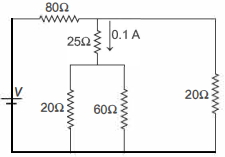
A current of $0.1 \,A$ flows through a $25 \,\Omega$ resistor represented by the circuit diagram. The current in $80 \,\Omega$ resistor is ........... $A$
A wire has resistance $12\,\Omega $. It is bent in the form of a circle. The effective resistance between the two points on any diameter is equal to ................ $\Omega$
Momentum of a photon of wavelength l is
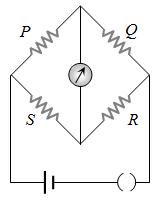
In the Wheatstone's bridge shown, P = 2 Ω, Q = 3Ω, R = 6Ω and S = 8Ω. In order to obtain balance, shunt resistance across 'S' must be

Unit of conductance is $......$
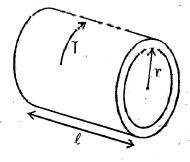
A hollow cylinder has length $l$ , radius $r$ , and thickness $d$ , where $l >> r >> d$ , and is made of a material with resistivity $\rho $ . A timevarying current $I$ flows through the cylinder in the tangential direction. Assume the current is always uniformly distributed along the length of the cylinder. The cylinder is fixed so that it cannot move; assume that there are no externally generated magnetic fields during the time considered for the problems below. Assume current at $t = 0$ to be $I_0$. What is current  $I(t)$ for $t > 0$
Boolean algebra is essentially based on
Susceptibility is positive and large for a: