MCQ
Which of the following alkyl groups has the maximum $+ I$ effect
- A$C{H_3} - $
- B${(C{H_3})_2}CH - $
- ✓${(C{H_3})_3}C - $
- D$C{H_3}C{H_2} - $
${(C{H_3})_3}C > {(C{H_3})_2}CH > C{H_3}C{H_2} > C{H_3}$
Generate a complete, print-ready paper with questions like this in minutes — across 16+ boards, with answer keys.
Statement $I:$ Primary aliphatic amines react with $HNO _{2}$ to give unstable diazonium salts.
Statement $II:$ Primary aromatic amines react with $HNO _{2}$ to form diazonium salts which are stable even above $300 \,K$.
In the light of the above statements, choose the most appropriate answer from the options given below:

${H_2}O(g) + C(s) \to CO(g) + {H_2}(g);\,\Delta H = 131\,kJ$$CO(g) + \frac{1}{2}{O_2}(g) \to C{O_2}(g);\Delta H = - 282\,kJ$
${H_2}(g) + \frac{1}{2}{O_2}(g) \to {H_2}O(g);\,\Delta H = - 242\,kJ$
$C(s) + {O_2}(g) \to C{O_2}(g);\,\Delta H = X\,kJ$ The value of $X$ is ......$kJ$
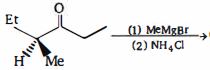
The decreasing order of the rate of the above reaction with nucleophiles $(Nu^-)$ $A$ to $D$ is
$[Nu^-=(A) \,PhO^-, (B)\,AcO^-, (C)\, HO^-, (D)\, CH_3O^-]$
