MCQ
Which of the following always has a negative value?
  • A
    Heat of reaction
  • B
    Heat of solution
  • C
    Heat of formation
  • Heat of combustion

Answer

Correct option: D.
Heat of combustion
(d) Heat of combustion
Explanation: Combustion is an exothermic process. Hence heat of combustion has a negative value.

Need a full question paper?

Generate a complete, print-ready paper with questions like this in minutes — across 16+ boards, with answer keys.

Start Generating Free

Similar questions

The first ionization energy for Li is $5.4 \,eV $ and electron affinity of $Cl$  is $3.61\,eV.$ The $\Delta H$ (in $kJ/mol$) for the reaction $Li(g) + Cl(g) \to L{i^ + } + C{l^ - }$ is (if resulting ions do not combine with each other) $(1\,eV = 1.6 \times {10^{ - 19}}\,J)$
The solubility of $AgCl_{(s)}$ with solubility product $1.6 \times 10^{-10}$ in $0.1\, M\, NaCl$ solution would be
Among the following species which two have trigonal pyramidal shape ?

$(I)$ $NI_3$                    $(II)$ $I_3^-$   

$(III)$ $SO_3^{-2}$         $(IV)$ $NO_3^-$

The number of possible isomers of the compound with molecular formula ${C_7}{H_8}O$ is
The rapid change of $pH $ near the stoichiometric point of an acid-base titration is the basis of indicator detection. $ pH $ of the solution is related to ratio of the concentrations of the conjugate acid $(HIn )$  and base $(I{n^ - })$forms of the indicator by the expression
In case of bonding molecular orbital the electron density is located:
A precipitate of $CaF_2$ $(K_{SP} = 1.7 \times 10^{-10})$ will be obtained when equal volume of the following are mixed
Two atoms are said to be isobars if:
Which of the following undergo friedal craft reaction
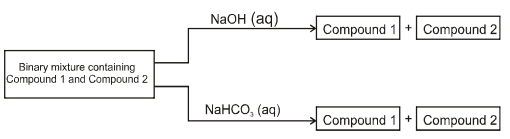
Identify the binary mixture$(s)$ that can be separated into individual compounds, by differential extraction, as shown in the given scheme.

$(A)$ $C _6 H _5 OH$ and $C _6 H _5 COOH$

$(B)$ $C _6 H _5 COOH$ and $C _6 H _5 CH _2 OH$

$(C)$ $C _6 H _5 CH _2 OH$ and $C _6 H _5 OH$

$(D)$ $C _6 H _5 CH _2 OH$ and $C _6 H _5 CH _2 COOH$