Question
Which of the following are quadratic equations$?$
$\text{x}-\frac{3}{\text{x}}=\text{x}^2$

Answer

Here it has been given that,
$\text{x}-\frac{3}{\text{x}}=\text{x}^2$
Now, solving the above equation further we get
$\frac{\text{x}^2-3}{\text{x}}=\text{x}^2$
$-x^3+x^2-3=0$
Now, the above equation clearly does not represent a quadratic equation of the form $a x^2+b x+c=0$, because $-x^3+x^2-3$ is a polynomial of degree $3 .$
Hence, the above equation is not a quadratic equation.

Need a full question paper?

Generate a complete, print-ready paper with questions like this in minutes — across 16+ boards, with answer keys.
Start Generating Free

Similar questions

Find the angle of elevation of the sum (sun's altitude) when the length of the shadow of a vertical pole is equal to its height.
Graphically, find whether the following pair of equations has no solution, unique solution or infinitely many solutions:
$5x - 8y + 1 = 0; ...(i)$
$3x -$ $\frac{24}{5}$$y$ $+$ $\frac{3}{5}$ $= 0 ...(ii)$
What is the nature of root of the quadratic equation $ 4 x^2-12 x-9=0 $.
A cottage industry produces a certain number of pottery articles in a day. It was observed on a particular day that cost of production of each article (in rupees) was $3$ more than twice the number of articles produced on that day. If, the total cost of production on that day was $₹ 90$, find the number of articles produced and the cost of each article.
Determine the nature of the root of the following quadratic equation:
$2 x^2-6 x+3=0$
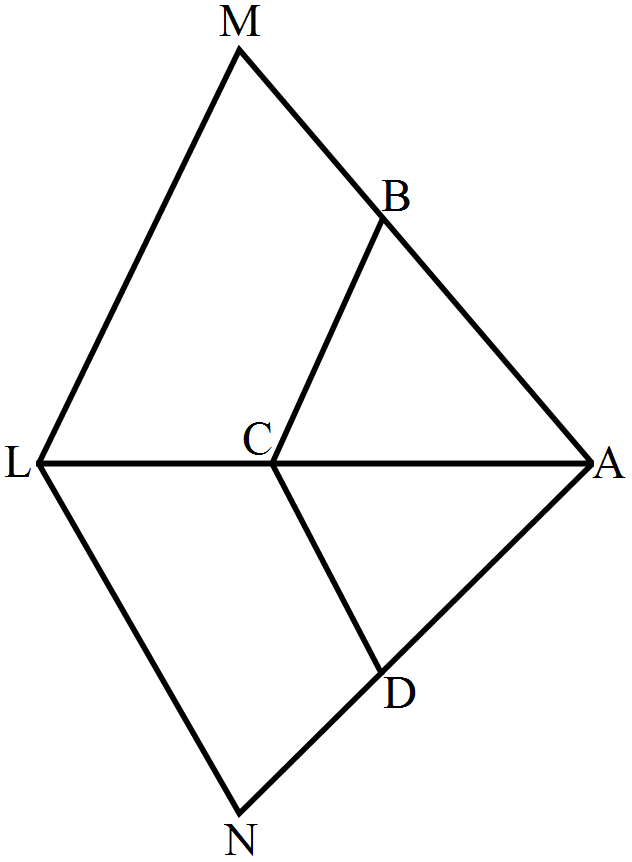
In the given figure, $LM || CD$.
Prove that $\frac{\text{AM}}{\text{AB}}=\frac{\text{AN}}{\text{AD}}.$
On comparing the ratios $\frac{\text{a}_1}{\text{a}_2},\frac{\text{b}_1}{\text{b}_2}$ and $\frac{\text{c}_1}{\text{c}_2},$ and without drawing them, find out whether the lines representing the following pairs of linear equations intersect at a point, are parallel or coincide.
$9x + 3y + 12 = 0$
$18x + 6y + 24 = 0$
Find:
$8^{th}$ term of the A.P. $117, 104, 91, 78, ......$
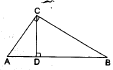
In the given figure, $\angle$ $ACB = 90^\circ$ and $CD$ $\perp$ $AB$. prove that $\frac { B C ^ { 2 } } { A C ^ { 2 } } = \frac { B D } { A D }$.

 
If $P(2, 6)$ is the mid-point of the line segment joining $A(6, 5)$ and $B(4, y),$ find $y.$