MCQ
Which of the following Boolean expression is not correct
  • A
    $\overline {\bar A.\bar B}  = A + B$
  • B
    $\overline {\bar A + \bar B}  = A.B$
  • C
    $\overline{\overline {A.B}}  = A.B$
  • $\bar 1 + \bar 1 = 1$

Answer

Correct option: D.
$\bar 1 + \bar 1 = 1$
d

Need a full question paper?

Generate a complete, print-ready paper with questions like this in minutes — across 16+ boards, with answer keys.
Start Generating Free

Similar questions

When a glass rod is rubbed with a piece of silk cloth the rod ?
Photoelectric effect was successfully explained first by
What determines the hardness of the $X-$ rays obtained from the Coolige tube
A transmitter transmits at a wavelength of $300\  meters$. A capacitor of a capacitance $9.6\ \mu F$ is being used. The value of the inductance for the resonant circuit is approximately.
When radiation of wavelength $\lambda$ is used to illuminate a metallic surface, the stopping potential is $V.$ When the same surface is illuminated with radiation of wavelength $3 \lambda,$ the stopping potential is $\frac{ V }{4} .$ If the threshold wavelength for the metallic surface is $n \lambda$ then value of $n$ will be......
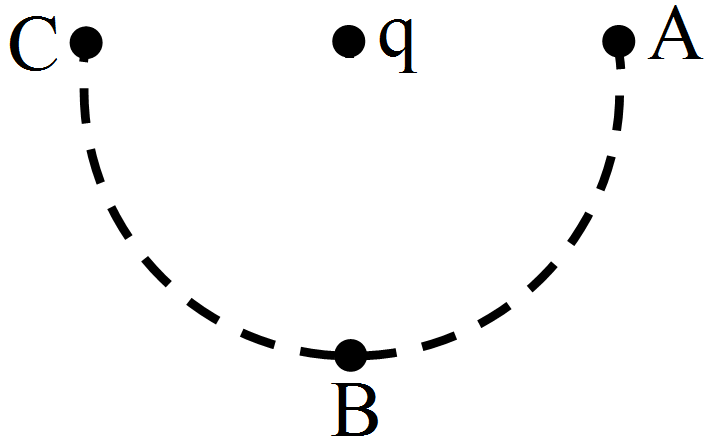
Consider the situation of figure. The work done in taking a point charge from $P$ to A is $W_A$, from $P$ to $B$ is $W_B$ and from $P$ to $C$ is $W_C$.
A nucleus $X$ undergoes following transformation

$X \stackrel{a}{\longrightarrow} Y$

$Y \underset{2 \beta}{\longrightarrow} Z$

then
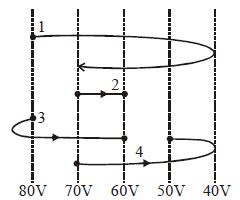
The figure shows a family of parallel equipotential surfaces and four paths along which an electron is made to move from one surface to another as shown in the figur
$(I)$ What is the direction of the electric field ?
$(II)$ Rank the paths according to magnitude of work done, greatest first
The de Broglie wavelength of an electron having kinetic energy $E$ is $\lambda$. If the kinetic energy of electron becomes $\frac{E}{4}$, then its de-Broglie wavelength will be :
A uniform electric field having a magnitude ${E_0}$ and direction along the positive $X - $ axis exists. If the potential $V$ is zero at $x = 0$, then its value at $X = + x$ will be