MCQ
Which of the following can react with $K _{2} Cr _{2} O _{7}$
  • $SO _{3}^{2-}$
  • B
    $CO _{3}^{-2}$
  • C
    $SO _{4}^{-2}$
  • D
    $NO _{3}^{-}$

Answer

Correct option: A.
$SO _{3}^{2-}$
a
$K _{2} Cr _{2} O _{7}$ being a strong oxidizing agent easily oxidizes $SO _{3}^{-2}$ to $SO_{4}^{-2} .$ The reaction is shown below.

$K _{2} Cr _{2} O _{7}+ SO _{3}^{-2} \rightarrow Cr ^{3+}+ SO _{4}^{-2}$

Need a full question paper?

Generate a complete, print-ready paper with questions like this in minutes — across 16+ boards, with answer keys.

Start Generating Free

Similar questions

Assertion : $NH_3$ is absorbed more readily over activated charcoal than $CO_2$.

Reason : $NH_3$ is non-polar.

In the following series of chemical reactions, identify  $Z $

${{C}_{3}}{{H}_{7}}OH\underset{160-{{180}\,^{o}}C}{\mathop{\xrightarrow{Conc.{{H}_{2}}S{{O}_{4}}}}}\,X\underset{{}}{\mathop{\xrightarrow{B{{r}_{2}}}}}\,Y\underset{Alc.KOH}{\mathop{\xrightarrow{\text{Excess of}}}}\,Z$
Prolonged heating is avoided during the preparation of ferrous ammonium sulphate to
Which quantum number is not related with Schrodinger equation
An aqueous solution of $CoC{l_2}$ on addition of excess of concentrated $ HCl $ turns blue due to formation of
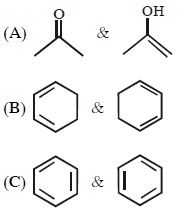
Which of the following pair of structure does not represent resonating structure
Isopropylbenzene on air oxidation in the presence of dilute acid gives
Given below are two statements : one is labelled as Assertion $A$ and the other is labelled as Reason $R$:

Assertion $A$: In the photoelectric effect, the electrons are ejected from the metal surface as soon as the beam of light of frequency greater than threshold frequency strikes the surface.

Reason $R$ : When the photon of any energy strikes an electron in the atom, transfer of energy from the photon to the electron takes place.

In the light of the above statements, choose the most appropriate answer from the options given below :

$C{H_3} - C{H_2} - C{H_2}Br + KOH{\rm{ (alc}}{\rm{.)}} \to {\rm{Product}}$

Product in above reaction is

Which of the following equilibria will shift to right side on increasing the temperature