MCQ
Which of the following cannot be emitted by radioactive substances during their decay
  • Proton
  • B
    Helium nucleus
  • C
    Positron
  • D
    Electron

Answer

Correct option: A.
Proton
a
(a)

Need a full question paper?

Generate a complete, print-ready paper with questions like this in minutes — across 16+ boards, with answer keys.
Start Generating Free

Similar questions

An $AC$ circuit has $R =100 \Omega, C =2\, \mu F$ and $L =80\, mH ,$ connected in series. The quality factor of the circuit is$.......$
Soap bubble appears coloured due to the phenomenon of
The ratio of the magnetic field at the centre of a current carrying circular wire and the magnetic field at the centre of a square coil made from the same length of wire will be
In a uniform electric field, the potential is $10$ $V $ at the origin of coordinates, and $8$ $V$ at each of the points $(1, 0, 0), (0, 1, 0) $ and $(0, 0, 1)$. The potential at the point $(1, 1, 1)$ will be....$V$
Out of gravitational, electromagnetic, Vander Waals, electrostatic and nuclear forces; which two are able to provide an attractive force between two neutrons
An $X-$ray has a wavelength of $0.010 Å$. Its momentum is
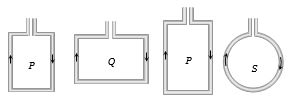
Four wires each of length $2.0\, metres$ are bent into four loops $P$, $Q$, $R$ and $S$ and then suspended into uniform magnetic field. Same current is passed in each loop. Which statement is correct
If two conducting spheres are separately charged and then brought in contact
Calculate the wavelength of light used in an interference experiment from the following data : Fringe width $=0.03\,cm$. Distance between the slits and eyepiece through which the interference pattern is observed is $1\,m$. Distance between the images of the virtual source when a convex lens of focal length $16\,cm$ is used at a distance of $80\,cm$ from the eyepiece is $0.8\,cm$.
The speed at which the current travels in a conductor, is nearly.