MCQ
Which of the following cannot be polarized?
- AUltraviolet rays
- BUltrasonic waves
- CX-rays
- DRadiowaves
Explanation:
All the longitudinal waves like sound etc cannot be polarized because the motion of the particles is already in one dimension that is the direction of propagation of wave.
Thus all the transverse waves like electromagnetic waves can be polarized.
Thus, (B) Ultrasonic waves being sound waves having frequency greater than 20kHz but being longitudinal in nature cannot be polarized
Generate a complete, print-ready paper with questions like this in minutes — across 16+ boards, with answer keys.
In the position of minimum deviation when a ray of yellow light passes through the prism, then its angle of incidence is
|
(a) Less than the emergent angle |
|
(b) Greater than the emergent angle |
|
(c) Sum of angle of incidence and emergent angle is 90° |
|
(d) Equal to the emergent angle |
A total charge Q is broken in two parts  and
and  and they are placed at a distance R from each other. The maximum force of repulsion between them will occur, when
|
(a) |
(b) |
|
(c) |
(d) |
A square metallic wire loop of side 0.1 m and resistance of 1W is moved with a constant velocity in a magnetic field of 2 wb/m2 as shown in figure. The magnetic field is perpendicular to the plane of the loop, loop is connected to a network of resistances. What should be the velocity of loop so as to have a steady current of 1mA in loop
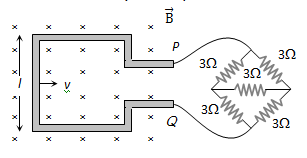
|
(a) 1 cm/sec |
(b) 2 cm/sec |
(c) 3 cm/sec |
(d) 4 cm/sec |
In a meter bridge, the balancing length from the left end (standard resistance of one ohm is in the right gap) is found to be 20 cm. The value of the unknown resistance is
|
(a) 0.8 Ω |
(b) 0.5 Ω |
(c) 0.4 Ω |
(d) 0.25 Ω |
In the spectrum of hydrogen atom, the ratio of the longest wavelength in Lyman series to the longest wavelength in the Balmer series is
| (a) 5/27 | (b) 1/93 |
(c) 4/9 |
(d) 3/2 |


