MCQ
Which of the following cannot be polarized?
  • A
    Ultraviolet rays
  • Ultrasonic waves
  • C
    $X-$rays
  • D
    Radiowaves

Answer

Correct option: B.
Ultrasonic waves

All the longitudinal waves like sound etc cannot be polarized because the motion of the particles is already in one dimension that is the direction of propagation of wave.
Thus all the transverse waves like electromagnetic waves can be polarized.
Thus, $(B)$ Ultrasonic waves being sound waves having frequency greater than $20\ kHz$ but being longitudinal in nature cannot be polarized

Need a full question paper?

Generate a complete, print-ready paper with questions like this in minutes — across 16+ boards, with answer keys.

Start Generating Free

Similar questions

A loop, made of straight edges has four corners at $A (L, L, O)$, $B(-L, L, O)$, $C(-L, -L, O)$, $D(L, -L, O)$. A magnetic field $\vec B = {B_0}\left( {\hat i + \hat k} \right)T$ is present in the region. The magnetic flux passing through the loop $ABCD$ is 
The first excited state of hydrogen atom is 10.2 eV above its ground state. The temperature is needed to excite hydrogen atoms to first excited level, is
If the momentum of a photon is $p$, then its frequency is

Where $m$ is the rest mass of the photon
An electron beam of energy $'10\,KeV'$ is incident on metallic foil. If the interatomic distance is $0.2454\,\mathop A\limits^o $ ; then find the angle of diffaction ................. $^o$ $\left( {\sqrt {150}  = 12.27} \right)$
In order to pass $10\,\%$ of main current through a moving coil galvanometer of $99\, ohm$, the resistance of the required shunt is ............ $\Omega $
A beam of natural light falls on a system of $6$ polaroids, which are arranged in succession such that each polaroid is turned through $30^o $ with respect to the preceding one. The percentage of incident intensity that passes through the system will be....$\%$
A candle placed 25 cm from a lens, forms an image on a screen placed 75 cm on the other end of the lens. The focal length and type of the lens should be
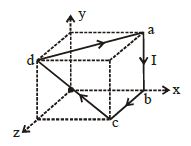
In figure the cube is of $40\,\, cm$ edge. Four straight segment of wire $ab, bc, cd$ and $da$ form a  closed loop that carries a current $I = 5\,A$. A uniform magnetic field $0.02\,\,T$ is in $+y\,-$ direction  ratio of magnetic force on segement $ab$  and $bc$  is
Assertion : Faraday’s laws are consequences of conservation of energy.
Reason : In a purely resistive ac circuit, the current lags behind the e.m.f. in phase.
Two identical tennis balls each having mass $m$ and charge $q$ are suspended from a fixed point by threads of length $l$. What is the equilibrium separation when each thread makes a small angle $\theta$ with the vertical?